You know you need sunscreen—it protects against UV damage, prevents dark marks from lingering, and keeps acne scars from getting worse. But every SPF you try seems to either break you out, feel greasy, or leave your skin looking like an oil slick by noon.
The frustrating truth? Most sunscreens aren’t designed with acne-prone skin in mind. Heavy creams, pore-clogging ingredients, and comedogenic formulas make the problem worse. But the right sunscreen exists—you just need to know what to look for.
At a Glance
- Look for: Non-comedogenic, oil-free, lightweight textures
- Best types: Gel, fluid, or serum sunscreens
- Avoid: Heavy creams, coconut oil, high-oleic oils
- SPF level: 30+ for daily, 50+ for outdoor activities
- Bonus ingredients: Niacinamide, zinc oxide (anti-inflammatory)
This is part of our complete guide to Sunscreen & Sun Protection.
60-Second Self-Check: Is Your Sunscreen Making Acne Worse?
Before we dive into solutions, let’s see if your current SPF is part of the problem.
Your sunscreen might be causing breakouts if:
- ☐ You notice new breakouts in areas where you apply the most sunscreen
- ☐ Your skin feels greasy or occlusive all day
- ☐ You break out more during summer (when you use more SPF)
- ☐ Your pores look larger or more clogged after applying
- ☐ The formula feels thick, heavy, or hard to spread
- ☐ You’ve avoided sunscreen because “it always breaks me out”
If you checked 2+ boxes, it’s time to switch to an acne-friendly formula. The good news: there are plenty that work.
Why Sunscreen Matters for Acne-Prone Skin
Skipping sunscreen because of breakout fears is one of the biggest skincare mistakes you can make. Here’s why:
UV makes acne problems worse:
- Post-inflammatory hyperpigmentation (PIH) — Those dark spots left after pimples? UV makes them darker and longer-lasting
- Acne scars become more visible — Sun damage emphasizes texture irregularities
- Inflammation increases — UV is inflammatory, worsening active breakouts
- Acne medications + sun = damage — Retinoids, BHAs, benzoyl peroxide all increase sun sensitivity
The catch: Wrong sunscreen causes new breakouts. Right sunscreen protects and even helps—some formulas contain ingredients that actively fight acne.
What to Look For: Acne-Friendly Sunscreen Features
Must-have labels:
- Non-comedogenic — Tested not to clog pores
- Oil-free — Won’t add excess sebum
- Lightweight / Gel / Fluid — Absorbs quickly without residue
- Matte finish — Controls shine instead of adding it
- Fragrance-free — Less irritation = less inflammation = fewer breakouts
Bonus ingredients that help:
| Ingredient | Why It Helps |
|---|---|
| Niacinamide | Controls sebum, reduces inflammation, fades dark marks |
| Zinc oxide | Mineral filter that’s naturally anti-inflammatory |
| Silica | Absorbs oil, creates matte finish |
| Green tea extract | Antioxidant, anti-inflammatory |
| Salicylic acid | Some sunscreens include this for pore-clearing |
What to Avoid: Ingredients That Clog Pores
These are commonly found in sunscreens and are known to cause breakouts in acne-prone skin:
Hard no’s:
- ❌ Coconut oil / Cocos nucifera oil — Highly comedogenic (rating 4/5)
- ❌ Isopropyl myristate — Common in sunscreens, clogs pores
- ❌ Isopropyl palmitate — Another pore-clogger
- ❌ Ethylhexyl palmitate — Occlusive, can cause breakouts
- ❌ Heavy mineral oils — Creates film that traps sebum
Proceed with caution:
- ⚠️ Shea butter — Great for dry skin, not for acne-prone
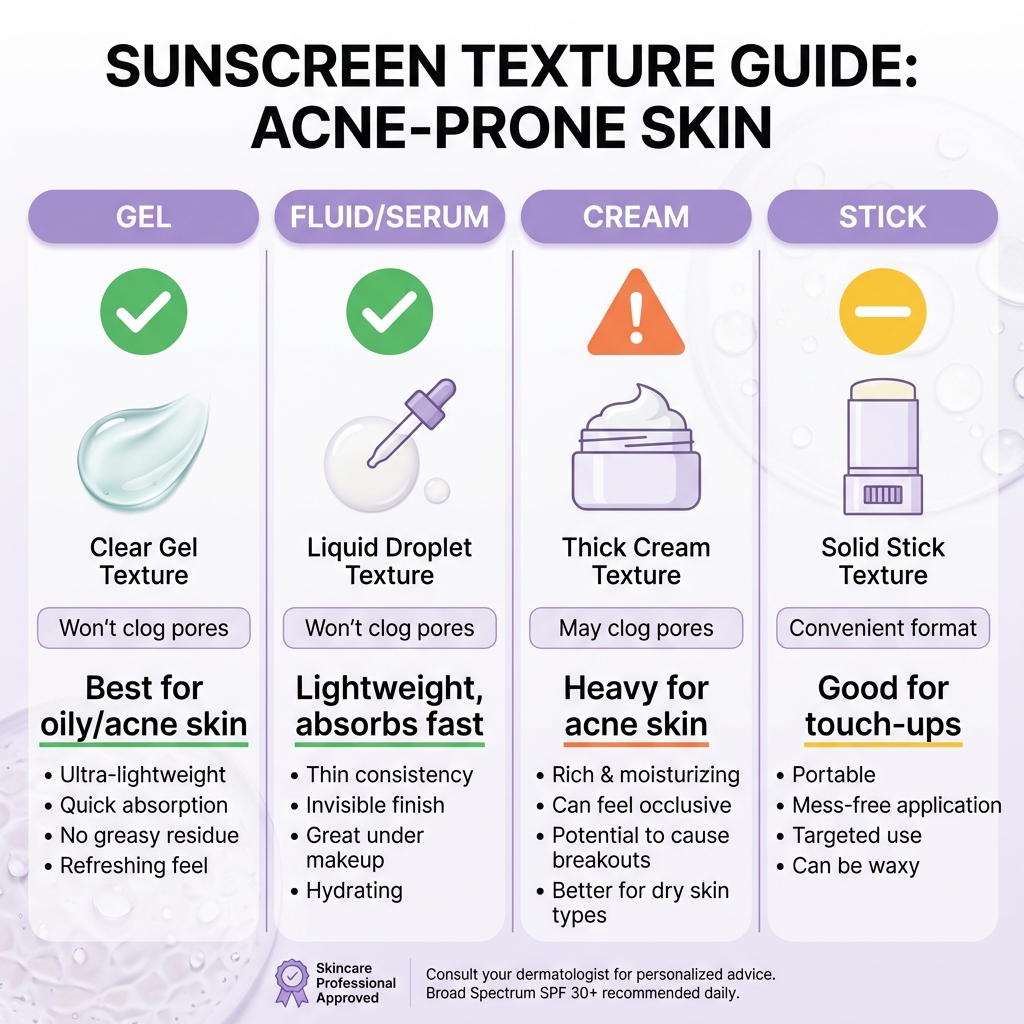
- ⚠️ Thick cream formulas — Heavy textures sit on skin
- ⚠️ Dimethicone (high percentage) — Some people break out; patch test
- ⚠️ Fragrance — Irritation can worsen acne
How to check: Use CosDNA, INCIDecoder, or similar ingredient checker websites to scan your sunscreen’s ingredient list for comedogenic ratings.
Best Sunscreen Types for Acne-Prone Skin
Gel Sunscreens ✓
Texture: Water-based, lightweight, absorbs quickly
Best for: Oily and acne-prone skin, humid climates
Why they work:
- No heavy oils or occlusives
- Often alcohol-free despite light texture
- Matte or natural finish
- Layers well under makeup
Fluid / Serum Sunscreens ✓
Texture: Ultra-thin, almost watery consistency
Best for: Those who want invisible SPF protection
Why they work:
- Fastest absorption
- Invisible on skin
- Works under any makeup
- Often includes skincare ingredients
Powder Sunscreens (Supplemental)
Texture: Loose or pressed powder with SPF
Best for: Touch-ups over makeup, oil control
Why they work:
- Absorbs excess oil
- Easy reapplication
- No disruption to makeup
- Note: Primary protection should still be liquid SPF
What to Avoid: Heavy Creams
Thick, white cream sunscreens designed for dry skin or body use are typically the worst for acne-prone faces. They:
- Create occlusive films
- Often contain comedogenic ingredients
- Take forever to absorb
- Leave greasy residue
Mineral vs. Chemical Sunscreen for Acne
Both can work for acne-prone skin—it depends on the formula, not the filter type.
Mineral (Physical) Sunscreen
Active ingredients: Zinc oxide, titanium dioxide
Pros for acne:
- Zinc oxide is naturally anti-inflammatory
- Sits on top of skin (doesn’t absorb into pores)
- Good for sensitive, reactive acne
Cons:
- Can leave white cast
- Some mineral creams are thick/occlusive
- May require more rubbing to blend
Best choice: Look for lightweight, tinted mineral sunscreens
Chemical (Organic) Sunscreen
Active ingredients: Avobenzone, octinoxate, homosalate, etc.
Pros for acne:
- Lighter textures available
- No white cast
- Easier to formulate as gels/fluids
Cons:
- Some people react to chemical filters
- May generate slight heat (not ideal for reactive skin)
Best choice: Look for oil-free, non-comedogenic chemical formulas
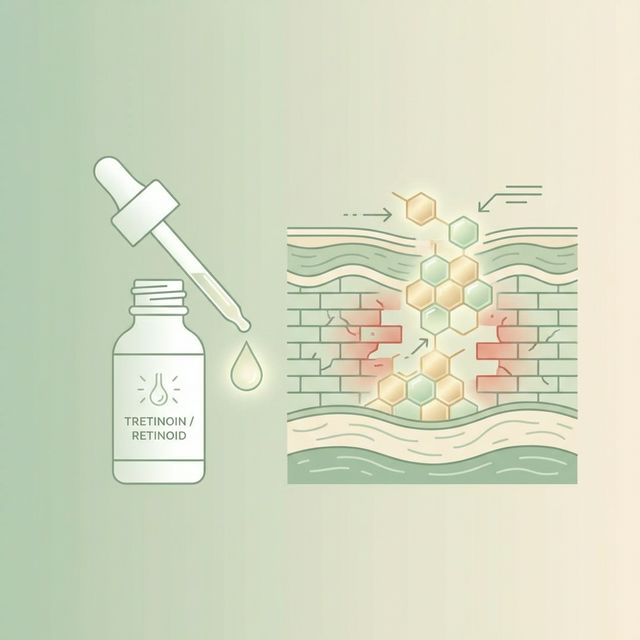
If you’re using acne medications: Retinoids (tretinoin, adapalene) and benzoyl peroxide increase sun sensitivity significantly. SPF 30+ is mandatory, SPF 50 is better. Don’t skip it.
How to Apply Sunscreen Without Causing Breakouts
Application technique matters. Here’s the acne-friendly method:
Step 1: Start with clean, moisturized skin
- If your skin is oily, you may skip moisturizer or use a lightweight gel moisturizer
- If using a treatment serum, let it absorb first (1-2 minutes)
Step 2: Use the right amount
- Two finger-lengths for face and neck
- Under-applying means under-protecting
Step 3: Pat, don’t rub aggressively
- Spread gently across face
- Then pat to press into skin
- Rubbing too hard can irritate and cause friction breakouts
Step 4: Let it set before makeup
- Wait 2-3 minutes before applying makeup
- This prevents pilling and ensures even coverage
Step 5: Don’t touch your face
- Every touch transfers bacteria and oil
- SPF also creates a slightly tacky surface that picks up debris
AM Routine for Acne-Prone Skin (with Sunscreen)
Morning Routine
- Gentle cleanser (or water rinse if dry)
- Acne treatment (if AM application)
- Lightweight moisturizer or skip
- Sunscreen SPF 30+ (final step)
- Wait 2-3 min, then makeup if desired
Key point: Sunscreen is always the last skincare step, before makeup. Nothing goes on top except cosmetics.
Reapplication for Acne-Prone Skin
Reapplication is where things get tricky. Here’s how to do it without messing up your skin:
When to reapply:
- Every 2 hours of sun exposure
- After sweating or water contact
- After touching/wiping your face
How to reapply without breaking out:
- SPF powder — Brush over face, absorbs oil while adding protection
- Setting spray with SPF — Light mist (check it’s non-comedogenic)
- Blot first — Remove excess oil, then pat on fresh sunscreen
- SPF stick for touch-ups — Less messy than liquids
Common Mistakes That Cause Sunscreen Breakouts
Mistake #1: Using body sunscreen on your face
Body sunscreens are thicker and more occlusive. Always use a formula specifically designed for face.
Mistake #2: Not washing off sunscreen properly
SPF can clog pores if left on overnight. Double cleanse in PM—oil-based cleanser first, then water-based.
Mistake #3: Layering SPF over too many products
More layers = more pore-clogging potential. Keep AM routine minimal.
Mistake #4: Skipping sunscreen because of breakouts
UV damage is worse than one pimple. Find the right formula instead of skipping.
Mistake #5: Assuming “natural” = better for acne
Many “natural” sunscreens use coconut oil and shea butter—both highly comedogenic. Read ingredients, not marketing.
FAQ
Does sunscreen cause acne?
The wrong sunscreen can. Comedogenic ingredients, heavy textures, and oil-based formulas can clog pores. But properly formulated, non-comedogenic sunscreens don’t cause acne—and actually help by preventing UV-induced inflammation.
Can I skip moisturizer if my sunscreen is hydrating?
Yes, sometimes. If your skin is oily and your sunscreen provides enough hydration, you can skip moisturizer in AM. But if your skin feels tight or you’re on drying acne medications, keep a lightweight moisturizer.
Is mineral or chemical sunscreen better for acne?
Either can work. It depends on the specific formula, not the filter type. Look for non-comedogenic, oil-free formulas in either category. Zinc oxide (mineral) has anti-inflammatory benefits; chemical formulas often have lighter textures.
Should I wear sunscreen if I have active breakouts?
Yes. Active breakouts are already inflamed—UV makes inflammation worse. Plus, healing pimples can leave dark marks that UV makes permanent. Use a gentle, non-comedogenic formula.
Why does my sunscreen make my face shiny?
It’s the formula. Look for “matte finish” or “dry touch” sunscreens. You can also set with SPF powder or translucent powder. Some natural shine is normal; oily-looking shine means the formula isn’t right for you.
Do I need sunscreen indoors?
If near windows, yes. UVA penetrates glass. If you’re in a windowless room, it’s less critical. But consistent daily use builds the habit and protects against incidental exposure.
The Bottom Line
Finding sunscreen for acne-prone skin isn’t impossible—you just need to know what to look for:
- Choose gel, fluid, or serum textures — Skip heavy creams
- Check for non-comedogenic, oil-free labels — These are designed for you
- Look for bonus ingredients — Niacinamide, zinc oxide, silica
- Avoid known pore-cloggers — Coconut oil, isopropyl myristate
- Apply properly — Pat gently, don’t over-layer, wash off at night
The best sunscreen is one you’ll actually wear. Once you find a formula that works, your skin will thank you—fewer dark marks, calmer inflammation, and no extra breakouts.
What to Read Next
- Start here: Sunscreen & Sun Protection Guide
- Application issues? Sunscreen Pilling & Texture Fix
- Acne routine: Acne & Breakouts Guide
- Get your personalized routine: Scan your skin with skncoach
This content is for informational purposes only and does not replace professional medical advice. If you have concerns about your skin, please consult a dermatologist.