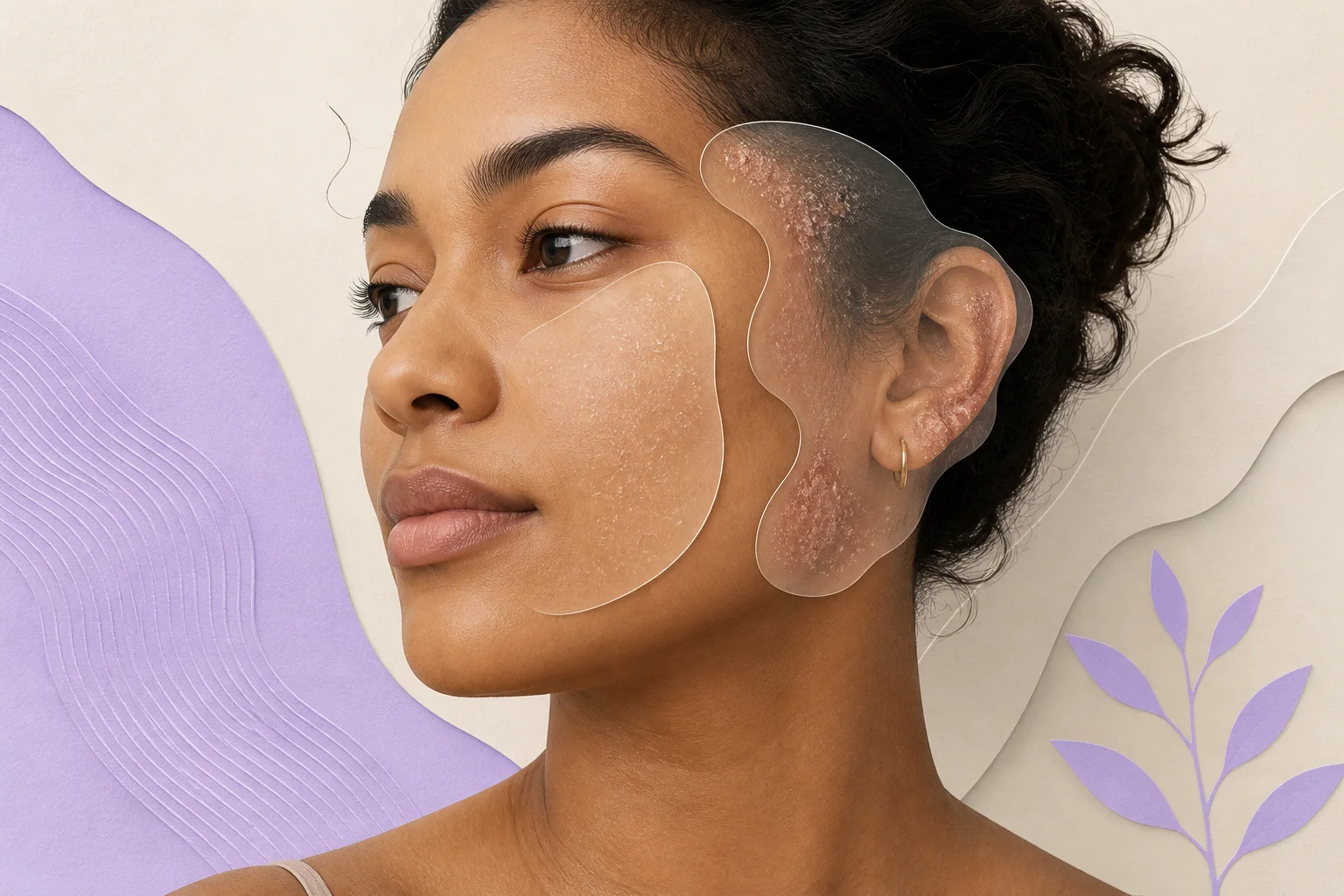
You keep adding moisturizer, but the flakes return in the same places. Your eyebrows shed. The sides of your nose look rough. Your scalp may join in. At that point, “dry skin” describes what you can see—not necessarily why it is happening.
Seborrheic dermatitis is one possible explanation. Eczema, psoriasis, rosacea, contact dermatitis, and simple irritation can overlap with it. The useful question is not “Which photo looks most like me?” It is “What pattern should make me stop product-hopping and get the diagnosis checked?”
At a Glance
- Simple dryness: Often more evenly spread and linked to harsh cleansing, hot water, dry weather, or too little moisturizer
- Seborrheic pattern: Often returns in oil-rich areas such as the scalp, eyebrows, sides of the nose, ears, hairline, or beard
- Important clue: Flaking plus itch or inflammation that keeps returning despite moisturizer deserves a closer look
- Do now: Simplify the routine, record the pattern, and stop adding untested actives
- Do not copy: A stranger’s antifungal-and-steroid mixture is not a diagnosis or a safe universal routine
- Get help: Persistent, spreading, painful, weeping, infected-looking, or eye-area symptoms need medical advice
This guide belongs to the Skin Barrier & Sensitivity hub.
Dry skin or a recurring flaky pattern?
These clues guide the next step; they do not diagnose.
More consistent with simple dryness
- Fine flaking is spread across several generally dry areas.
- It feels tight or uncomfortable more than itchy.
- A gentler wash and a familiar fragrance-free moisturizer noticeably help.
Worth checking for seborrheic dermatitis or another condition
- Flaking repeatedly returns around the scalp, eyebrows, hairline, sides of the nose, ears, eyelids, or facial hair.
- More moisturizer has not solved the pattern.
- Other conditions can look similar.
60-second pattern check
More consistent with simple dryness
- Fine flaking is spread across several generally dry areas.
- Skin became rough after a cleanser change, hot showers, cold weather, travel, or over-exfoliation.
- It feels tight or uncomfortable more than itchy.
- A gentler wash and a familiar fragrance-free moisturizer noticeably help.
- The scalp, eyebrows, nose folds, ears, and beard are not repeatedly involved.
Worth checking for seborrheic dermatitis or another condition
- Flaking repeatedly returns around the scalp, eyebrows, hairline, sides of the nose, ears, eyelids, or facial hair.
- The same areas look inflamed, discolored, itchy, or oily as well as flaky.
- Dandruff and facial flaking rise and fall together.
- More moisturizer has not solved the pattern.
- Stress, cold dry weather, heat, or sweating seem to precede a repeat flare.
- You have tried several “barrier repair” products and the texture keeps returning.
None of these clues confirms a diagnosis. Seborrheic dermatitis can look dry and scaly or oily and inflamed. Other conditions can occupy the same facial zones, and more than one condition can exist at once.
The difference that matters
Dry skin is a state. The surface lacks enough water and protective lipids to feel comfortable. Weather, hot water, repeated washing, irritating products, age, and underlying skin conditions can all contribute.
Seborrheic dermatitis is an inflammatory condition. It tends to affect areas with more sebaceous glands and often follows a recurring flare-and-calm pattern. Yeast that normally lives on human skin is involved in the condition, but that does not make it “fungal acne,” contagious, or proof that the skin is dirty.
That distinction changes the job:
| If the main job is… | A sensible first move is… |
|---|---|
| Reducing ordinary dryness | Gentler cleansing, shorter lukewarm washing, and a familiar fragrance-free moisturizer |
| Identifying a recurring rash | Documenting the distribution and asking a clinician to examine it |
| Managing diagnosed seborrheic dermatitis | Following the treatment and maintenance plan prescribed for your sites, age, hair type, and health |
Why “more moisturizer” can fail
Moisturizer can reduce dryness and help irritated skin feel more comfortable. It does not establish why a rash keeps returning.
If inflammation is driving the scale, adding thicker and thicker layers may leave the underlying condition untreated. A heavy product may also irritate some people or make an occluded facial area feel worse. That does not mean “barrier products feed fungus” as a universal rule. It means the product, location, and diagnosis matter.
The same caution applies in the other direction: one quick response to an antifungal product does not prove seborrheic dermatitis. Several conditions fluctuate naturally. Products can contain multiple ingredients. A before-and-after photo cannot isolate the cause.
A calm seven-day holding pattern
This is not a treatment for seborrheic dermatitis. It is a low-noise routine to stop creating new variables while you arrange care or observe the pattern.
Morning
- Wash only if you need to. Use lukewarm water and your fingertips.
- If cleanser is needed, choose a familiar gentle, fragrance-free one and rinse it fully.
- Apply a familiar moisturizer that does not sting.
- Use sun protection you already tolerate.
Evening
- Remove sunscreen and makeup without scrubbing.
- Pause optional exfoliating acids, cosmetic retinoids, scrubs, peels, essential oils and fragranced experiments on flaky areas. For prescribed treatment, follow the medicine leaflet’s reaction advice and contact your prescriber about changes.
- Moisturize for comfort rather than layering several new “repair” products.
Record four things
- Where: scalp, hairline, brows, eyelids, nose folds, ears, beard, chest, or elsewhere
- What it feels like: itch, burn, sting, tenderness, or only dryness
- What changed: weather, stress, sweat, illness, hair products, makeup, or medication
- What touched it: every cleanser, cream, active, steroid, antifungal, hair product, and prescription
One clear week of notes is often more useful than five new products introduced at once.
Do not make a DIY facial steroid plan from a Reddit routine. Corticosteroids can be appropriate for some diagnosed conditions, but potency, location, duration, and withdrawal matter. They can also mask or aggravate other facial rashes. If you already use a prescribed, inhaled, or nasal steroid, ask the prescriber how it relates to the rash rather than stopping it on your own.
What a clinician may need to separate
A clinician can examine the shape, scale, distribution, scalp, nails, and other skin—not just one cropped phone photo. They may consider:
- simple dry or irritated skin;
- seborrheic dermatitis;
- atopic or contact dermatitis;
- psoriasis or overlapping seborrheic dermatitis and psoriasis;
- rosacea or periorificial dermatitis;
- a fungal or bacterial infection; or
- another less common cause.
Most cases can be assessed from history and examination. When the pattern is unclear, a clinician may use a scraping, swab, patch testing, or occasionally a biopsy to rule out a look-alike.
When to get medical help
Arrange a routine appointment if the flaking keeps returning, involves several classic zones, does not improve with a gentle routine, or is affecting sleep, confidence, work, or daily life.
Seek more prompt advice if you notice:
- spreading redness or discoloration, warmth, swelling, pus, yellow crust, or increasing pain;
- cracking, bleeding, open skin, or a rash that is rapidly worsening;
- eyelid swelling, eye pain, light sensitivity, vision change, or significant eye irritation;
- widespread rash, fever, or feeling unwell; or
- a reaction after starting a new medication or using a potent product.
Start with the most accessible appropriate clinician where you live: primary care, telehealth, or dermatology. A pharmacist may help you choose the right service, but persistent facial rashes still need a diagnosis rather than endless over-the-counter trials.
Questions worth taking to the appointment
- Does the distribution look like seborrheic dermatitis or a look-alike?
- Could a hair, skin, dental, inhaled, or nasal product be contributing?
- Which treatment is for the flare, and which is for maintenance?
- Where exactly should each medication go, and for how long?
- What should make me stop or contact you?
- How should the plan change near my eyes, in facial hair, or on my scalp?
FAQ
Is seborrheic dermatitis the same as fungal acne?
No. “Fungal acne” usually refers to Malassezia folliculitis, which affects hair follicles and presents as bumps. Seborrheic dermatitis is an inflammatory, scaly condition with a different pattern. They can both involve Malassezia yeast, but they are not interchangeable diagnoses.
Can seborrheic dermatitis look like dry skin?
Yes. It can look dry and scaly, especially on the face. The recurring distribution—often scalp, eyebrows, nose folds, ears, or beard—adds useful context.
Should I wash flaky skin less?
Do not scrub or repeatedly strip it. Gentle washing can still remove scale, sweat, and residue. The correct frequency and any medicated wash depend on the diagnosis and the sites involved.
Can I use dandruff shampoo on my face?
Some clinicians recommend specific medicated washes for diagnosed facial seborrheic dermatitis. The ingredient, contact time, frequency, and proximity to the eyes matter. Ask for a plan instead of improvising from a scalp label.
Related guides
- How to wash your face with a damaged skin barrier
- Why skincare suddenly burns or stings
- How to repair your skin barrier
- Rosacea routine
Sources and review notes
- American Academy of Dermatology: Seborrheic dermatitis diagnosis and treatment
- American Academy of Dermatology: Seborrheic dermatitis self-care
- American Academy of Dermatology: Ten reasons your face can be red
This guide helps you organize symptoms and choose a next step. It cannot diagnose a facial rash or replace care from a qualified clinician.