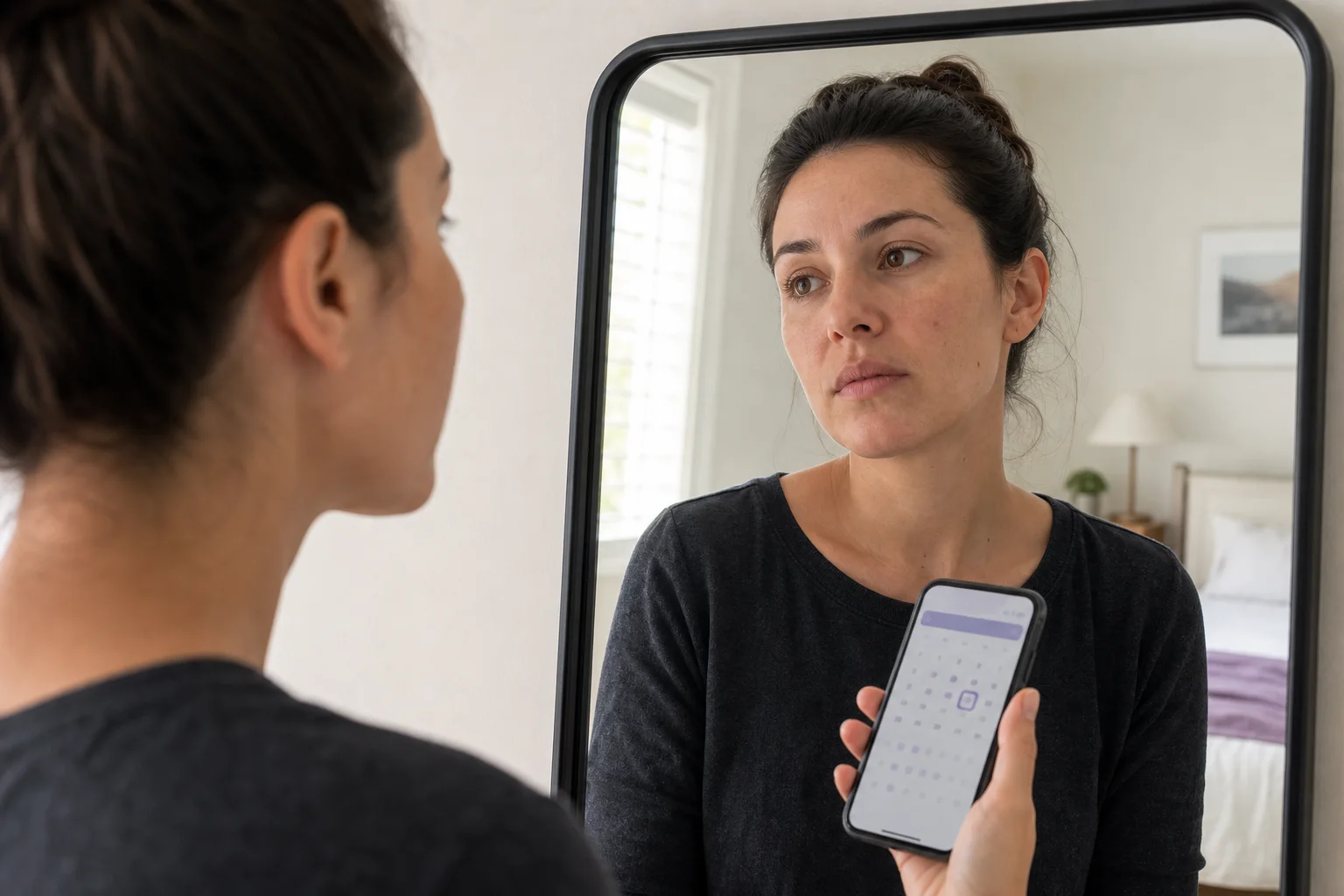
A cluster of bumps appears around your mouth, so you treat it like acne. You add salicylic acid, benzoyl peroxide, or a retinoid. The bumps stay. The skin gets drier, tighter, or more irritated. Then every new breakout looks like proof that you need a stronger acne routine.
That loop can continue for months because periorificial dermatitis—often called perioral dermatitis when it centers around the mouth—can look acne-like without being acne.
The safest goal is not to diagnose it from a chart. It is to notice when the pattern no longer behaves like ordinary acne and stop escalating the wrong treatment.
At a Glance
- More like acne: Blackheads or whiteheads, mixed lesion types, and breakouts across typical acne zones
- Could be periorificial dermatitis: Many small similar bumps around the mouth, nostrils, or eyes with dryness, scale, burning, or tightness
- A useful clue: The narrow skin edge directly beside the lips may stay clear in periorificial dermatitis
- Do now: Pause new experiments, photograph the pattern, and list every product and steroid exposure
- Do not do: Start facial hydrocortisone, antibiotics, or antifungals based on a social post
- Get help: Persistent or spreading facial bumps need a clinician, especially near the eyes or when treatment keeps failing
This guide belongs to the Acne & Breakouts hub.
Acne—or an acne look-alike?
Use the pattern to choose care. Do not use it to diagnose yourself.
Clues that lean toward acne
- Blackheads or whiteheads are part of the picture.
- Lesions vary: clogged pores, inflamed pimples, and sometimes deeper nodules.
- Breakouts also appear on the forehead, cheeks, jaw, chest, shoulders, or back.
Clues that should raise periorificial dermatitis
- Many bumps are small and similar in size.
- They cluster around the mouth, sides of the nose, or eyes.
- The immediate border beside the lips looks relatively spared.
- Facial steroid exposure is important to mention.
60-second pattern check
Clues that lean toward acne
- Blackheads or whiteheads are part of the picture.
- Lesions vary: clogged pores, inflamed pimples, and sometimes deeper nodules.
- Breakouts also appear on the forehead, cheeks, jaw, chest, shoulders, or back.
- The skin between lesions is not consistently dry, scaly, burning, or tight.
- The pattern is not concentrated around facial openings.
Clues that should raise periorificial dermatitis
- Many bumps are small and similar in size.
- They cluster around the mouth, sides of the nose, or eyes.
- The immediate border beside the lips looks relatively spared.
- Surrounding skin is dry, flaky, tight, itchy, or burning.
- Facial corticosteroid use preceded the pattern or briefly made it look better before it returned.
- A heavy, changing routine and repeated acne treatments keep making the area more reactive.
The name “perioral” can be misleading: the same type of eruption can appear around the nose or eyes, which is why clinicians often use periorificial dermatitis.
Side-by-side: what changes the decision?
| Question | Acne | Periorificial dermatitis pattern |
|---|---|---|
| Are blackheads or whiteheads present? | Common | Not typical |
| Are the bumps all very similar? | Often mixed | Often clustered and similar |
| Where is it? | Any acne-prone zone | Around mouth, nostrils, or eyes |
| Does the skin burn or feel tight? | Possible with irritating treatment | Can be part of the eruption |
| Is the lip edge spared? | No reliable pattern | Often, though not always |
| Do facial steroids matter? | Not a typical acne treatment | Important association and possible aggravator |
No single row settles the diagnosis. Contact dermatitis, rosacea, folliculitis, impetigo, and other conditions can imitate parts of either column.
The common mistake: treating uncertainty with more force
When acne treatment fails, the understandable response is to add more:
- a stronger acid;
- a second exfoliant;
- a harsher cleanser;
- a spot treatment under an occlusive patch;
- an antifungal “just in case”; or
- hydrocortisone because the redness looks inflammatory.
Each addition creates a new irritant or changes the appearance a clinician needs to evaluate. Topical corticosteroids deserve special caution. They may temporarily suppress redness while aggravating or masking periorificial dermatitis, and a flare can occur when a potent facial steroid is changed or stopped.
Do not start a facial steroid for acne-like bumps. If a clinician prescribed a topical, inhaled, nasal, or oral steroid, do not stop medically necessary treatment on your own. Tell the prescriber where the rash is and ask how to adjust safely.
A low-noise plan while you arrange care
The purpose is to preserve information and reduce avoidable irritation—not to treat a condition you have not confirmed.
1. Stop adding optional products
Pause new acids, scrubs, retinoids, spot treatments, essential oils, fragranced products, and home remedies on the affected area. If a medication was prescribed, contact the prescriber before changing it.
2. Keep cleansing gentle
Use lukewarm water and fingertips. Choose a familiar mild cleanser only if needed. Do not scrub scale or bumps away.
3. Make a complete exposure list
Include items people often forget:
- prescription and over-the-counter facial creams;
- nasal sprays, inhalers, and nebulizer masks;
- toothpaste and mouth products;
- sunscreen, makeup, lip products, and makeup remover;
- shaving products and facial-hair products; and
- recent antibiotics, hormones, or medication changes.
An association does not prove causation. The list helps a clinician see the full context.
4. Photograph the distribution
Take a clear photo in the same light every few days. Include the mouth, nose, eyes, chin, and both cheeks rather than cropping tightly around one bump. Note burning, itch, tightness, or scale separately—photos do not record sensation.
5. Avoid a five-variable elimination test
Reddit threads often name toothpaste, dairy, whey, vitamin supplements, hormones, sunscreen, and dozens of products. Changing all of them at once creates a strict routine without producing a reliable answer. A clinician can help rank the plausible exposures.
What a clinician may do
Periorificial dermatitis is usually diagnosed from the history and examination. When the picture is unclear, a clinician may use a swab, scraping, patch test, or occasionally a biopsy to rule out infection, allergy, or another rash.
Treatment depends on age, pregnancy, severity, location, prior steroid exposure, other medication, and the clinician’s diagnosis. It may involve removing aggravating products and using a prescribed topical or oral medicine. That is why a copied antibiotic, antifungal, or steroid schedule does not belong in a general article.
When to get medical help
Book routine care if:
- small facial bumps persist despite a simpler routine;
- the eruption repeatedly returns around the mouth, nose, or eyes;
- burning, tightness, scale, or itch accompanies the bumps;
- facial steroid exposure may be involved; or
- “acne” treatment keeps worsening the area.
Seek prompt care for eye pain, light sensitivity, vision change, significant eyelid swelling, rapidly spreading redness or discoloration, severe pain, fever, honey-colored crust, pus, or feeling unwell.
Primary care, telehealth, or dermatology may be appropriate depending on access and severity. A pharmacist can help you identify the right local route and review non-prescription products, but persistent facial eruptions still need a diagnosis.
Bring these questions
- Do you see comedones, or does this look like a dermatitis pattern?
- Could a steroid, inhaler, nasal spray, cosmetic, or dental product matter?
- Which products should I stop, and which prescribed medicines must continue?
- If a steroid needs changing, how should that happen safely?
- What improvement should I expect, and when should I contact you again?
- What signs would suggest allergy, infection, rosacea, or another look-alike?
FAQ
Is perioral dermatitis a type of acne?
No. It is an inflammatory facial eruption that can look acne-like. Unlike acne, blackheads, cysts, and nodules are not typical.
Can it appear around the nose or eyes?
Yes. “Periorificial dermatitis” covers eruptions around the mouth, nostrils, and eyes.
Does toothpaste cause it?
Dental products are reported associations, not a universal cause. Do not assume one ingredient explains every mouth-area rash. Bring the product list to a clinician and change one plausible exposure at a time if advised.
Can I use hydrocortisone to calm it?
Do not start facial hydrocortisone for an undiagnosed acne-like eruption. Topical steroids can aggravate or mask periorificial dermatitis. If you already use a prescribed steroid, ask the prescriber before changing it.
Why did a steroid make it look better at first?
Steroids suppress inflammation, so redness can temporarily fall. The eruption may return or flare with continued use or withdrawal. That short-term response does not prove the steroid was the right treatment.
Related guides
- Closed comedones: how to clear them
- Common skincare mistakes that worsen breakouts
- Why skincare burns or stings
- Rosacea routine
Sources and review notes
- American Academy of Dermatology: Is stubborn acne really acne?
- DermNet: Periorificial dermatitis
- DermNet: Topical corticosteroids
This guide cannot diagnose a rash from its location or appearance. Persistent facial bumps and any medication changes should be reviewed by a qualified clinician.