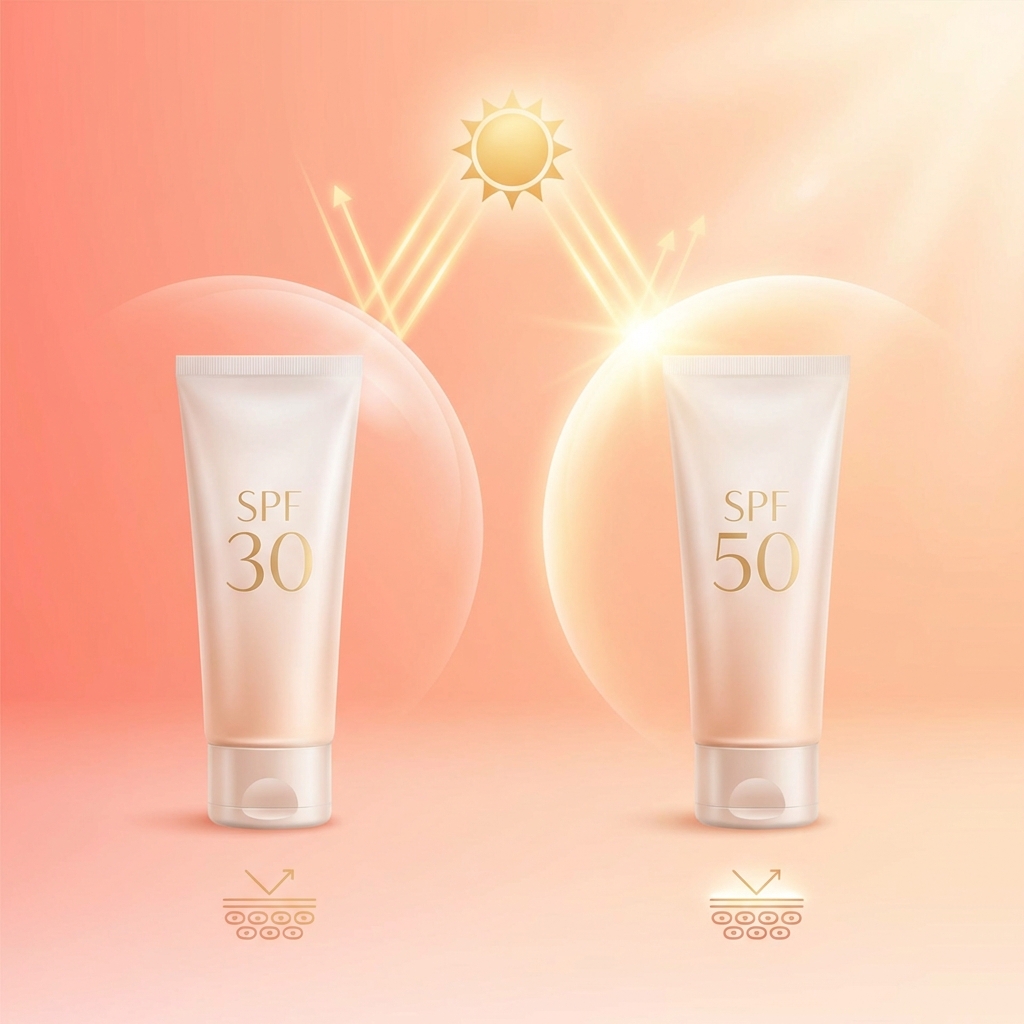
SPF 50 provides greater tested sunburn protection than SPF 30, but neither number describes an all-day shield. Your choice also needs broad-spectrum protection, a formula you can use at the required amount, and a practical plan for reapplication and other protection.
You do not have to choose between caring about the number and caring about how you apply it. Both matter. The useful comparison is between complete products and the way you will use them, rather than between two numbers in isolation.
At a Glance
- Start with the essentials: The AAD recommends broad-spectrum, water-resistant SPF 30 or higher.
- Higher SPF can help: Do not dismiss it as meaningless, but do not use it as permission to apply less.
- SPF is not a time allowance: It does not tell you how many extra hours you can safely stay outside.
- No simple half-dose rule: Less sunscreen means less reliable protection, not a predictable new SPF.
- Keep the full plan: Read the label, reapply as directed, and use shade, clothing, a hat, and sunglasses.
For the wider topic, visit Sunscreen & Sun Protection.
What SPF Actually Measures
SPF stands for sun protection factor. It compares the UV exposure needed to produce sunburn with and without a sunscreen under defined test conditions. It primarily describes protection against UVB, rather than providing a complete rating for UVA, visible light, or every effect of sunlight.
The FDA explains that SPF relates to the amount of solar exposure, not directly to time outdoors. Conditions change with place, time of day, and activity. Multiplying your usual time to burn by the SPF number is not a safe planning method.
A careful look at the familiar percentages
The table below uses the simplified calculation 100 × (1 − 1/SPF). It helps explain why familiar percentages look close together. These are mathematical approximations for understanding the rating, not measurements of the protection on your face today or of all solar wavelengths.
| Labelled SPF | Approximate reduction in sunburn-effective UV in the simplified model | Approximate fraction remaining |
|---|---|---|
| 15 | 93.3% | 6.7% |
| 30 | 96.7% | 3.3% |
| 50 | 98.0% | 2.0% |
| 100 | 99.0% | 1.0% |
The values do not show your personal cancer-risk reduction, predict a melasma outcome, or tell you how much protection remains after swimming. They also do not establish that a small percentage-point difference is irrelevant. Avoid both extremes: treating high SPF as complete protection, or treating every product above SPF 30 as equivalent.
What the Evidence Does and Does Not Say
The American Academy of Dermatology recommends SPF 30 or higher with broad-spectrum protection and water resistance. Higher SPF can offer additional protection, especially when real-world application falls short. That is not a reason to deliberately under-apply.
In a randomized beach study of SPF 50+ and SPF 100+ products, 55 participants used the products on different sides of the face and body for up to five days. The higher-SPF side had less sunburn overall. Only the initial application was monitored, the study was small, and it tested particular products; some authors were employed by the manufacturer. It does not provide an exact SPF 30-versus-50 benefit for your routine, but it argues against dismissing all higher-SPF protection as useless.
You do not need to calculate your personal benefit from one study before buying sunscreen. Use the evidence to avoid misleading shortcuts, then choose a suitable product you can apply and replenish as directed.
Why Half the Amount Is Not Half the SPF
The labelled protection depends on the product being tested and used at an appropriate amount. A thin film or missed patches can reduce protection. There is no universal conversion that turns half an application of SPF 50 into SPF 25.
A study of sunscreen thickness and sunburn protection tested products at several application amounts and found that the relationship differed between formulas and SPF levels. That supports a practical conclusion: do not calculate a dependable lower SPF from how little you applied.
If a sunscreen only feels wearable in a very thin layer, compare another suitable formula. A higher number cannot reliably repair skipped areas. For help with coverage, see How Much Sunscreen to Apply on Face.
Questions That Help You Choose
This is a planning check, not a score that assigns a medically correct SPF.
| Question | What it changes in the plan |
|---|---|
| Will I be outdoors for a long period or around water? | Choose a suitable water-resistant product and plan full reapplication and shade |
| Do I burn easily or have a history that needs extra protection? | Discuss the appropriate level and wider protection plan with a clinician |
| Am I managing melasma or another light-sensitive condition? | Ask about UVA, visible light where relevant, and treatment-specific advice |
| Am I using a medicine or recovering from a procedure? | Follow the exact medicine or aftercare instructions; ask the prescriber if unclear |
| Can I apply the full amount comfortably? | Compare the actual texture, finish, and cost at full use |
| Can I carry and reapply it when needed? | Choose packaging and a routine that work in the real setting |
A brief commute is not a promise of zero UV exposure. Equally, no one can infer your exact exposure from the word indoors alone. Think about windows, time outside, shade, and any clinician instructions rather than treating a lifestyle label as a guarantee.
Medicines, Procedures, and Skin Conditions
The FDA’s medicine-and-sun guidance explains that some medicines can increase sun sensitivity. It does not mean every acne medicine, serum, or retinoid has identical effects. Read your own product information and ask a pharmacist or prescriber about precautions.
After a procedure, follow the treating clinician’s advice about when and where to apply sunscreen, particularly if skin is broken or healing. Do not replace that advice with a higher number or add a product that stings because you think protection requires enduring pain.
For dark marks or melasma, the SPF number is only part of the discussion. The pigmentation sunscreen guide explains why a clinician may recommend a tinted iron-oxide formula as part of a broader plan.
Check UVA Protection Separately
Broad-spectrum protection matters alongside SPF. Different markets use different labels, so do not assume a familiar front-of-pack number tells you everything.
- United States: Broad spectrum indicates that the product meets the relevant UVA and UVB testing requirements. It is not a separate numerical UVA score.
- European guidance: The European Commission recommendation recommends UVA protection of at least one-third of the SPF, alongside a critical-wavelength criterion. This is regional guidance, not a rule for every country.
- PA-labelled products: The Japan Cosmetic Industry Association explains PA as a UVA-protection grade. More plus signs indicate a higher grade within that system. PA is not the SPF number or a visible-light rating.
Do not add or convert these labels into a personal protection score. If you are comparing products sold under different systems, check the manufacturer’s actual local label and ask for help if a medical condition requires a specific recommendation.
Application and Reapplication Work Together
Use the product’s directions for the intended area, amount, and timing. Do not assume every nozzle delivers the same amount along two fingers. Spread enough for even coverage and include the exposed areas you intend to protect.
Reapply according to the label, including after swimming, sweating, or towel drying. Water resistance has limits. There is no universal table that can tell you the exact SPF left on your skin at lunch or after a particular amount of sweat.
Make the plan practical. If you will be outdoors, pack the product and identify a place where you can reapply with clean hands. If makeup makes that hard, plan how to adjust it rather than counting a quick powder dusting as a complete replacement application.
A Simple Routine
Morning
- Use your usual gentle cleansing and moisturizing steps as needed.
- Follow the directions for any medicine in your morning plan.
- Apply a suitable broad-spectrum sunscreen in the amount and timing its label directs.
- Add makeup if wanted without disturbing the sunscreen layer.
- Take clothing, a hat, sunglasses, and enough product for the day’s reapplication needs.
Evening
- Remove sunscreen and makeup gently with a cleanser you tolerate.
- Add a second removal step only if needed; it is not a requirement for every sunscreen.
- Follow your agreed treatment plan and moisturize as needed.
- Check that your sunscreen is ready for the next day rather than adding unnecessary nighttime SPF.
Common Mistakes
Turning SPF into extra time outside. The number is not permission to extend exposure. Shade and clothing still matter.
Buying a high number and using less. You cannot assume a predictable level of protection from a reduced dose. Compare full-application comfort when choosing a product.
Declaring all high-SPF formulas thick or greasy. Texture belongs to the finished formula, not the number alone. Compare the products you can actually buy and use.
Adding SPF numbers together. SPF 30 plus SPF 50 does not make SPF 80. Mixing or layering products does not establish a new tested SPF, and the higher number is not automatically guaranteed if coverage is disrupted.
Ignoring storage and expiry. Follow the bottle’s instructions. Do not infer an exact remaining SPF from how hot a product became; ask the manufacturer or pharmacist if its condition is uncertain.
FAQ
Is SPF 50 worth a higher price?
It can provide greater tested sunburn protection, but compare cost, broad-spectrum coverage, tolerance, and the amount you will actually use. There is no universal price rule that makes SPF 30 or SPF 50 the right purchase for everyone.
Does darker skin need sun protection?
Yes. Choose suitable broad-spectrum protection regardless of skin tone. If dark marks or melasma are a concern, ask about visible-light protection as well; SPF alone does not answer that question.
Can a well-used SPF 30 beat a poorly used SPF 50?
Application can substantially affect protection, but a slogan cannot quantify a particular comparison. Do not use this as a reason to dismiss higher SPF or to accept poor application. Aim for an appropriate product used correctly.
Does SPF 50 mean I do not need to reapply?
No. Follow reapplication directions for the exact product and your activities. No SPF number replaces them.
What about babies and children?
Use age-appropriate protection and follow local pediatric guidance and the product label. For babies younger than six months, prioritize shade and protective clothing and ask a clinician before using sunscreen. Do not choose a higher SPF as a substitute for careful application or supervision.
What to Read Next
- Sunscreen & Sun Protection Guide
- How Much Sunscreen to Apply on Face
- How to Fix Sunscreen White Cast
- Mineral vs Chemical Sunscreen
Keep your chosen products organized: Use skncoach’s product tracker to record your routine. It cannot measure the SPF on your skin or calculate a safe time to remain in the sun.
This guide provides general information, not a diagnosis or an individual treatment plan.