You applied sunscreen before makeup. Now you need another application while outdoors, and you would like to keep your makeup in place. There is no technique that guarantees both an untouched finish and the labelled protection.
Start with a product you can apply generously and evenly according to its directions. If your makeup prevents that, the makeup may need to be removed or redone. A neat-looking touch-up cannot establish the SPF you are getting.
At a Glance
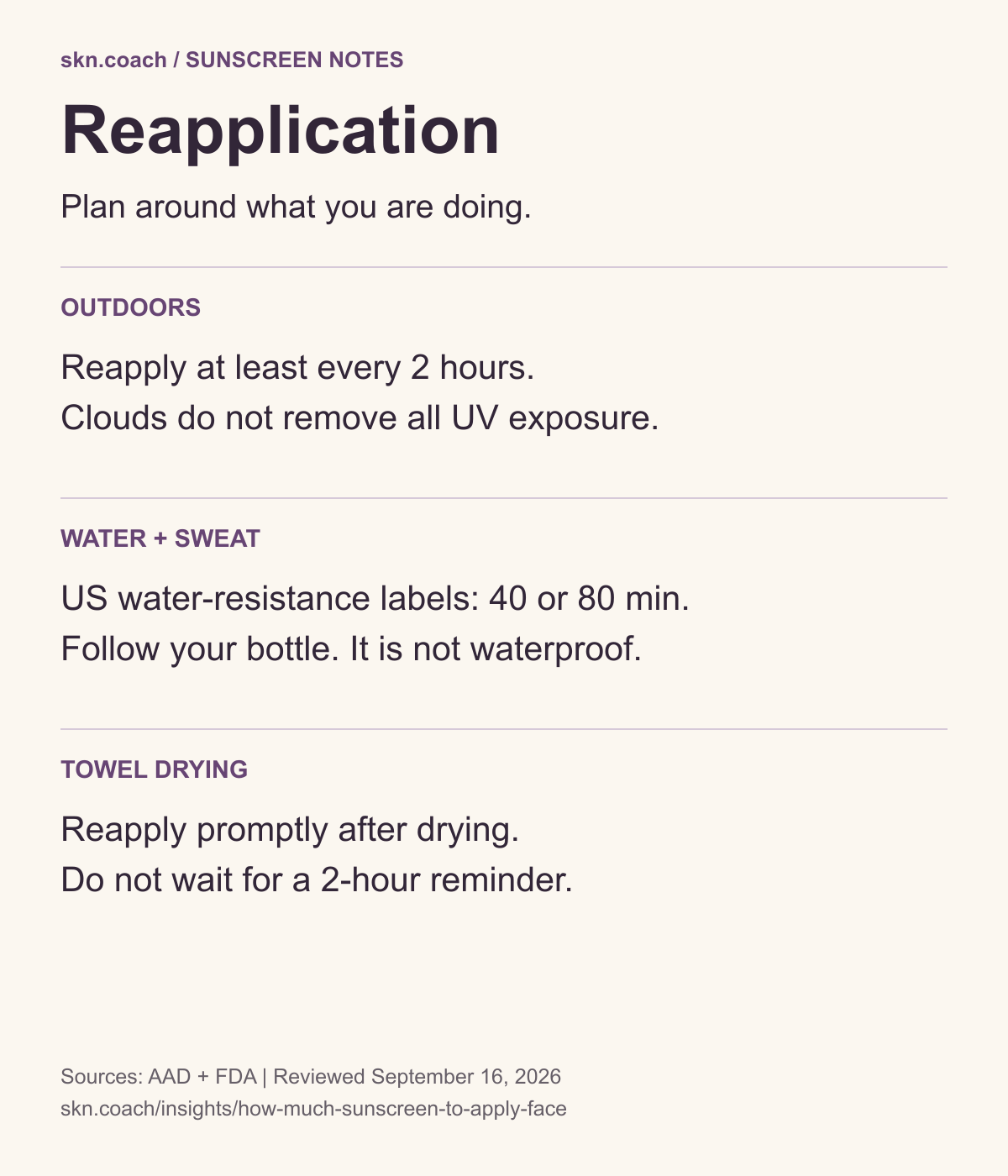
- Timing: Outdoors, reapply at least every two hours and as directed after swimming or sweating; reapply after towel drying
- Amount: Do not reduce the amount to preserve makeup
- Sprays: Apply to your hands first for facial use; never spray directly onto your face
- Cushions and powders: Check the actual sunscreen directions; coverage or a matte finish is not a dose measurement
- Backup plan: Carry sunscreen you can use properly, and use shade, protective clothing, a hat and sunglasses
This is part of our complete guide to Sunscreen & Sun Protection.
A Quick Check Before Your Next Day Out
Think through the day rather than giving yourself a protection score:
- Will you be outdoors long enough to need another application?
- Will swimming, sweating or towel drying change the timing?
- Can you apply the amount on your label over the makeup you plan to wear?
- Can you cover every exposed area, including ears, hairline and neck?
- Do you have a place to wash your hands and redo makeup if needed?
- Could a lighter makeup routine make reapplication easier?
These questions help with planning. Pinkness, a smooth finish or a checklist result cannot measure how much UV protection remains on your skin.
Comparing Reapplication Formats
A format is useful only if you can follow its instructions. Start with the exact product, not a rule that all sprays, cushions or powders work the same way.
Option 1: Lotion, Cream or Fluid Sunscreen
A product you already tolerate may be a practical option. Read its directions before deciding whether to apply it over makeup.
- Move out of direct sun while arranging the application.
- Clean your hands and check whether sweat, dirt or makeup prevents even coverage.
- Apply the labelled amount across all exposed areas, using the product’s application method.
- If the layers clump, smear or leave gaps, do not assume another cosmetic dusting has repaired the coverage. Remove or redo makeup as needed so you can apply sunscreen properly.
- Allow the product to set according to its directions before touching up makeup.
This may change the finish. Try the combination on an ordinary day before relying on it for a long outdoor event.
Option 2: A Sunscreen Spray Used as Directed
Do not spray sunscreen directly onto your face. The FDA’s sunscreen guidance warns against direct facial spraying.
For a spray suitable for facial use, the AAD advises spraying onto your hands first, then applying to your face. Avoid inhalation, follow the instructions for even coverage, and keep flammable products away from flames and heat.
A fixed number of mists is not a reliable dose for every product. Closing your eyes does not make direct facial spraying appropriate, and the spray may disturb makeup when applied correctly.
Option 3: Cushion or Compact Sunscreen
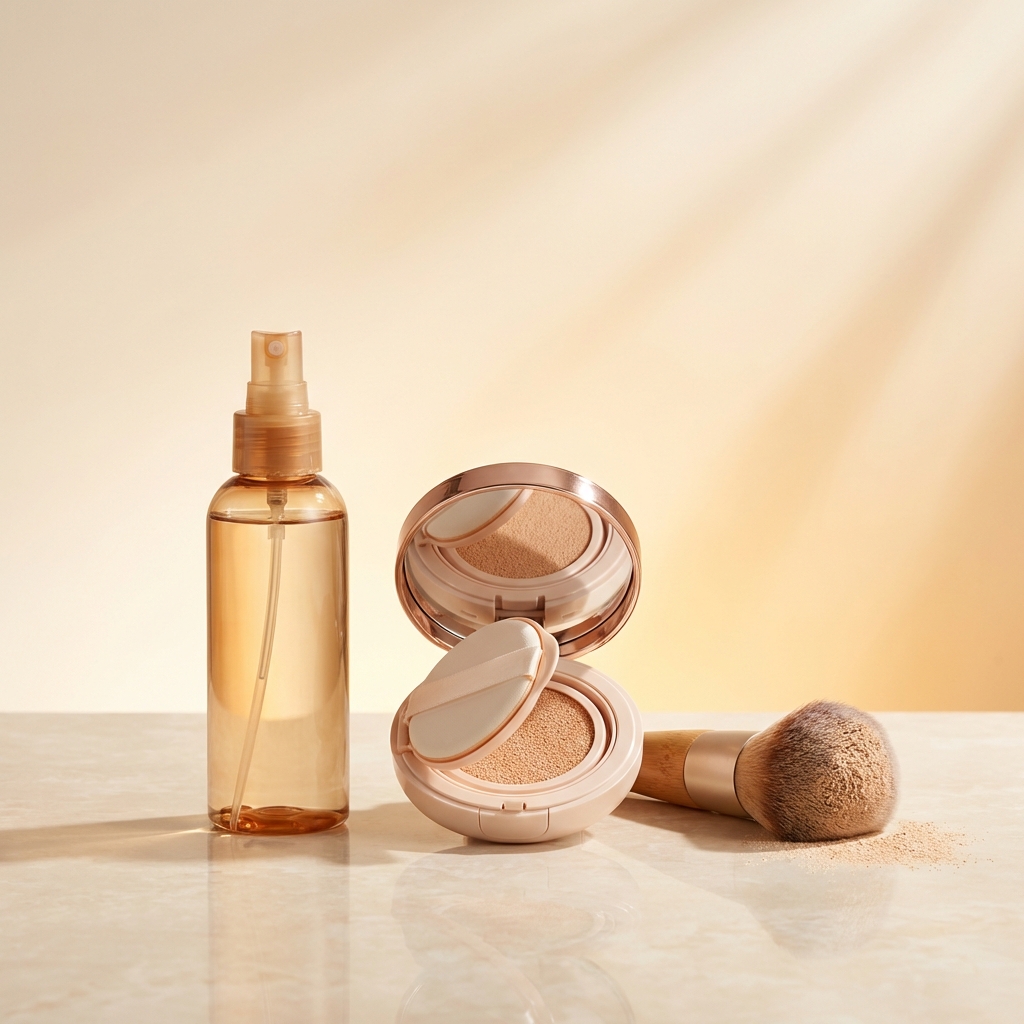
A compact may be convenient to carry, but it can contain sunscreen, makeup with SPF, or a different cosmetic product. Check which one you have and read the application instructions.
- A cushion puff does not measure how much sunscreen reaches your skin.
- Apply across all exposed areas, not just the nose or cheekbones.
- A good shade match and even foundation coverage do not establish an adequate sunscreen amount.
- Keep the applicator clean according to its instructions.
- If you cannot apply the required amount comfortably, choose another sunscreen format for reapplication.
Patting may preserve some makeup better than rubbing, but it is not a universal sunscreen rule. Follow the product’s method and do not trade even coverage for an untouched finish.
Option 4: Powder With SPF
A powder can change the look of shine, but a light brush pass is not evidence of sufficient sunscreen coverage. Do not assume that a powder touch-up renews your morning sunscreen or gives the labelled SPF.
Read the exact product directions, including amount, coverage and any inhalation cautions. If you cannot apply it as directed, use another sunscreen that you can apply properly. A morning application does not remove the need for adequate reapplication later outdoors.
Choose by the Task, Not a Skin-Type Shortcut
| Your situation | What to check | Practical fallback |
|---|---|---|
| Dry or easily irritated skin | Whether the complete formula feels comfortable | Ask about alternatives if stinging or a rash persists |
| Oily skin or a matte makeup finish | Whether you can apply enough without relying on a dusting | Use a sunscreen you tolerate and adjust makeup afterward |
| Full-coverage makeup | Whether the layers allow even sunscreen application | Remove or redo makeup if needed |
| Minimal makeup | Whether your usual sunscreen can be reapplied as directed | Keep the routine simple for outdoor days |
| Swimming or heavy sweating | Water-resistance and reapplication directions | Carry a suitable product and reapply after towel drying |
No row guarantees that a format is suitable for everyone with that skin type.
Morning Preparation and Later Reapplication
Morning Routine
- Use gentle skincare and any prescribed treatment as directed.
- Apply a broad-spectrum sunscreen with SPF 30 or higher, using its labelled amount and method.
- Leave the pre-exposure time required by the product. The AAD generally recommends applying sunscreen about 15 minutes before going outdoors.
- Apply makeup without deliberately wiping away the sunscreen.
- Pack the sunscreen, clean application supplies and any makeup you may need to redo.
Reapplication Outdoors
- Check the time and any swimming, sweating or towel drying.
- Find a practical place to apply sunscreen evenly.
- Follow the full product directions across all exposed areas.
- If blotting, wiping or removing makeup takes sunscreen off, reapply properly; cosmetic tidying does not restore protection.
- Touch up makeup only after the sunscreen application is complete.
Common Mistakes
Treating a Nice Finish as Proof of Protection
A mirror can show streaks or clumps, but it cannot measure SPF. Keep the amount and timing on the label even when makeup looks unchanged.
Reapplying Only to the Most Visible Areas
Nose and cheekbones are not the whole exposed surface. Include the ears, hairline, neck and other uncovered areas.
Assuming a Higher SPF Fixes a Smaller Amount
Choose broad-spectrum SPF 30 or higher, but do not use a high number as permission to apply less or wait longer. The label still matters.
Waiting Until the Skin Looks Burned
Do not use redness as your reapplication reminder. Plan around exposure and product directions, including on cloudy days.
FAQ
Can foundation with SPF be my only sunscreen?
Only a product used in the amount and manner required by its sunscreen directions can be relied on for its labelled protection. Ordinary cosmetic coverage may not meet that requirement. There is no universal number of foundation layers that proves your SPF. If you cannot use the foundation as directed for sun protection, use a separate sunscreen you can apply properly.
How do I reapply near my eyes?
Follow the sunscreen’s eye-area warnings and keep it out of your eyes. Do not spray near the face. A product’s powder or mineral label does not guarantee comfort around the eyes. Use sunglasses and a hat, and ask for advice if products repeatedly sting.
Do I need to reapply indoors?
Consider actual UV exposure, including time near windows and trips outdoors, rather than assuming every indoor setting is the same. Ask a clinician for an individual plan if a skin condition or medicine makes sun protection especially important.
Will a spray preserve my makeup?
It depends on the complete formula and makeup combination. Correct facial application involves your hands and may move makeup. Do not replace the directions with a misting shortcut to protect the finish.
Can I apply sunscreen over setting spray?
Check both products’ instructions and whether you can achieve an even application. There is no universal compatibility guarantee. If setting products prevent proper sunscreen application, simplify or redo the makeup.
Make the Next Application Possible
Choose the sunscreen and makeup together for the day you are planning. A portable product, enough time and a willingness to touch up makeup are more useful than a promised invisible shortcut.
Use Skin Coach to organize your routine and notes about product comfort. A photo scan cannot measure sunscreen coverage or tell you the SPF remaining on your skin.
What to Read Next
- Start here: Sunscreen & Sun Protection Guide
- How much to apply? Amount, Coverage, and Reapplication
- Pilling issues? Sunscreen Pilling & Texture Fix
- Download: Sunscreen Amount & Reapply Cheat Sheet
Sources
- American Academy of Dermatology: How to apply sunscreen
- American Academy of Dermatology: Sunscreen FAQs
- American Academy of Dermatology: Stick and spray sunscreens
- FDA: Sunscreen and sun protection
This guide is for general information. Follow the directions for your sunscreen and seek medical advice for persistent irritation or individual sun-protection needs.