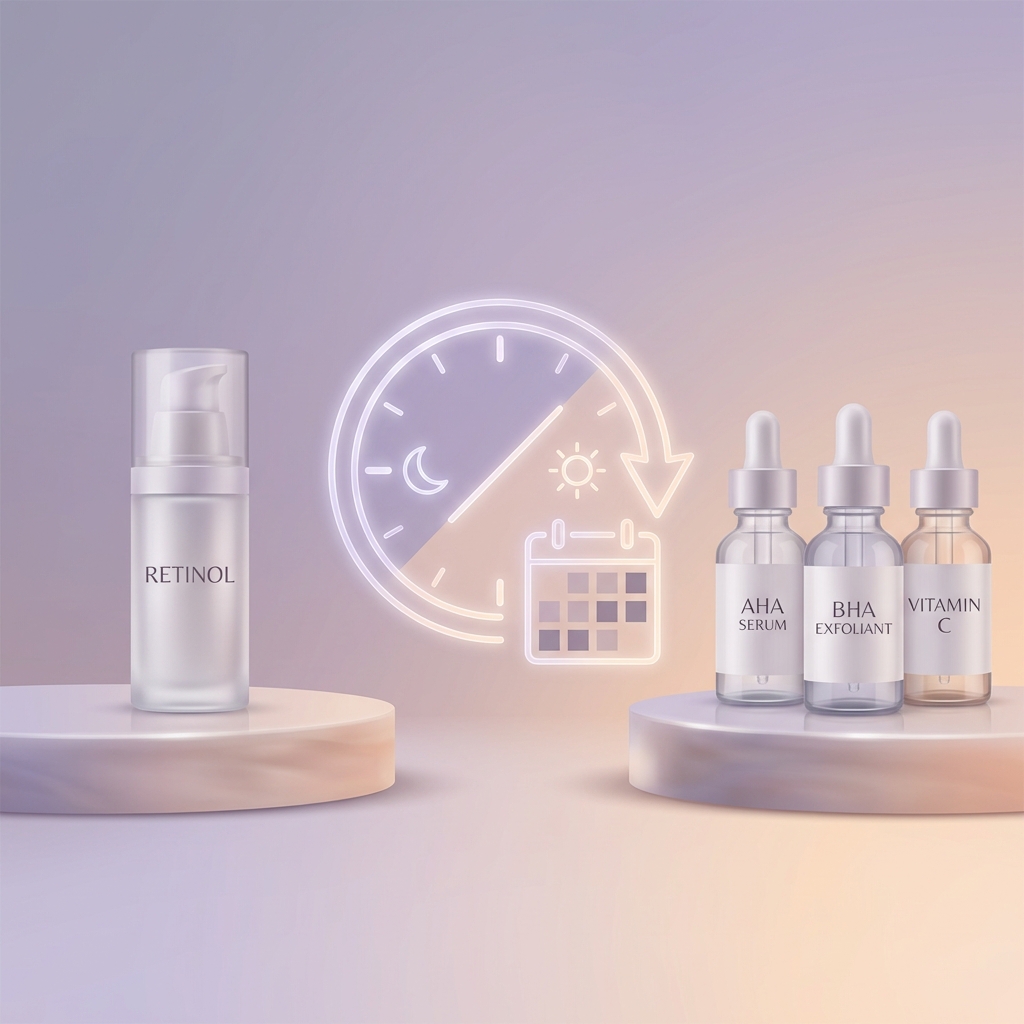
You’ve got your retinoid working—now you want to add an acid for extra exfoliation, brightness, or acne control. But everything you read says “don’t mix actives.” So what’s actually safe?
The truth: you can combine retinoids with acids, but timing and tolerance matter. Here’s exactly how to do it without wrecking your barrier.
At a Glance
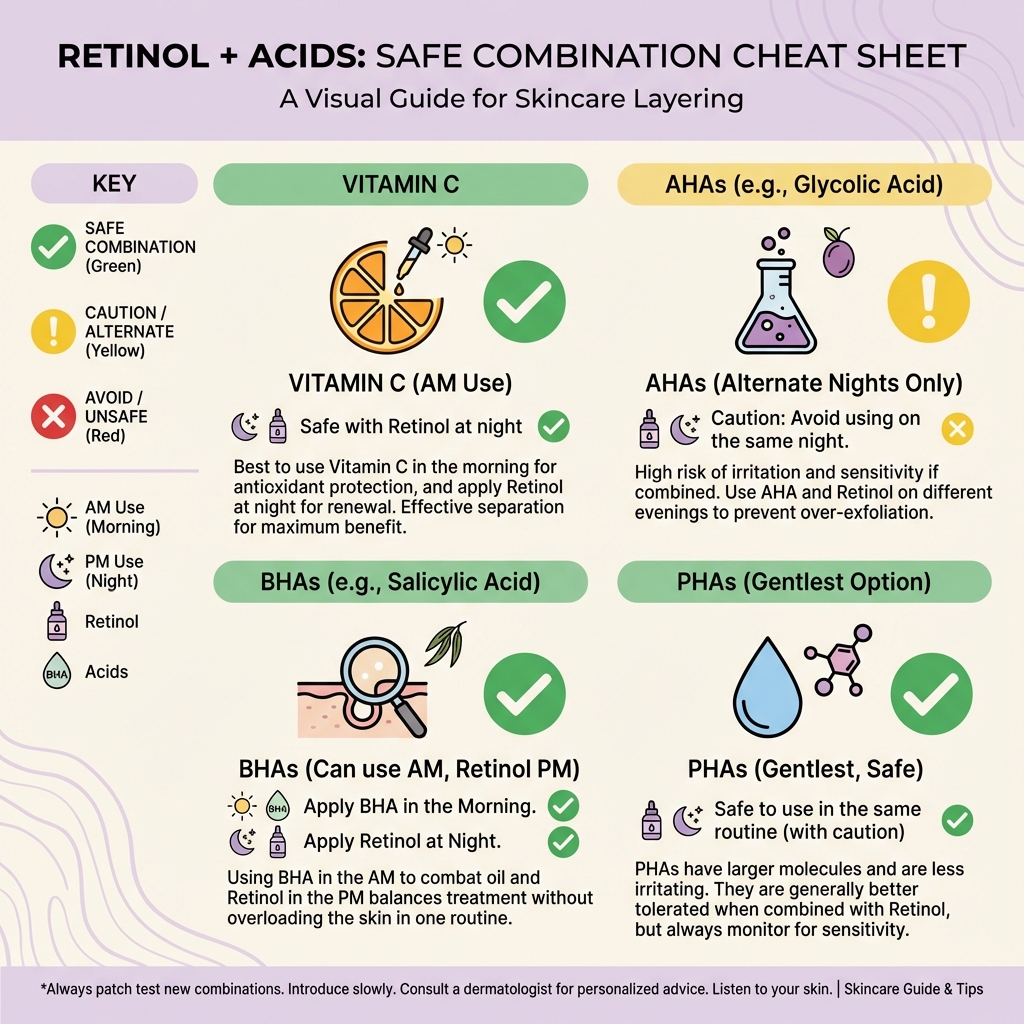
- Vitamin C: Safe in AM while retinoid at night (different times = OK)
- AHAs (glycolic, lactic): Alternate nights only—never same night as retinoid
- BHAs (salicylic): Gentler, can use AM while retinoid PM if tolerated
- PHAs: Gentlest acids, easiest to combine with retinoids
- Golden rule: Wait until your skin tolerates retinoid alone (4+ weeks stable) before adding any acid
This is part of our complete Retinoids Guide.
60-Second Self-Check: Are You Ready to Add Acids?
YES, you can add acids if:
- ☐ You’ve used your retinoid for 4+ weeks with no irritation
- ☐ No redness, peeling, or stinging from your current routine
- ☐ Your barrier feels healthy (no tightness, burning with products)
- ☐ You’re using retinoid at least 3x/week consistently
WAIT before adding acids if:
- ☐ You’re still adjusting to your retinoid (less than 4 weeks)
- ☐ You’re experiencing any irritation, peeling, or sensitivity
- ☐ You recently increased retinoid strength or frequency
- ☐ Your skin feels compromised or reactive
The rule: Get stable on retinoid first. Adding acids to already-irritated skin creates an irritation spiral that can take weeks to repair.
Acid-by-Acid Breakdown
Vitamin C (L-Ascorbic Acid)
Verdict: Safe to use with retinoids
Vitamin C is an antioxidant, not an exfoliant. Despite the low pH, it works differently than AHAs/BHAs and doesn’t increase irritation risk the same way.
How to combine:
- Use vitamin C in the morning (antioxidant protection under SPF)
- Use retinoid at night (renewal while you sleep)
- This separation eliminates any potential interaction issues
The old myth: “Vitamin C and retinol cancel each other out.” This is outdated. Studies show they work fine together—just at different times for optimal stability.
Pro tip: If you want to use vitamin C at night with retinoid, apply vitamin C first, wait 15-20 minutes, then apply retinoid. But AM/PM separation is simpler.
AHAs (Glycolic Acid, Lactic Acid, Mandelic Acid)
Verdict: Alternate nights only—high irritation risk
AHAs are powerful exfoliants that work on the skin’s surface. Combining with retinoids (which also increase cell turnover) can easily over-exfoliate and damage your barrier.
How to combine:
- Never use AHAs and retinoids on the same night
- Alternate: Retinoid Monday, AHA Tuesday, Retinoid Wednesday, etc.
- Start with AHA only 1-2x/week while maintaining retinoid schedule
- Build up slowly over months, not weeks
Which AHAs are gentler?
- Mandelic acid: Largest molecule, slowest penetration, good starting point
- Lactic acid: Medium strength, also hydrating
- Glycolic acid: Smallest molecule, most potent, highest irritation risk
Warning: If you’re using tretinoin or a strong retinoid, AHAs may be unnecessary. Your retinoid is already providing significant exfoliation. Adding AHAs often causes problems without extra benefit.
BHAs (Salicylic Acid)
Verdict: Can use AM while retinoid PM—gentler option
Salicylic acid is oil-soluble and anti-inflammatory, making it gentler than AHAs for most skin types. It’s also better for acne-prone skin and works synergistically with retinoids for pore clearing.
How to combine:
- Option 1: BHA in the morning, retinoid at night (safest)
- Option 2: Alternate nights (if using strong BHA like 2%)
- Start with low concentration BHA (0.5–1%) if using with retinoid
Why BHA is easier to combine:
- Anti-inflammatory properties reduce irritation
- Doesn’t thin the skin barrier like AHAs
- Works inside pores (different mechanism than surface exfoliation)
PHAs (Polyhydroxy Acids)
Verdict: Gentlest option—easiest to combine
PHAs (gluconolactone, lactobionic acid) have the largest molecules, meaning slowest penetration and least irritation. They also have humectant properties.
How to combine:
- Can often use same routine as retinoid (apply PHA, wait, then retinoid)
- Or use AM while retinoid PM
- Best choice if you have sensitive skin but want exfoliation
Step-by-Step: Adding Acids to Your Retinoid Routine
Phase 1: Establish Retinoid Tolerance (Weeks 1-6)
Before adding any acid, your retinoid routine should be stable:
- Using retinoid 3-4x/week minimum
- No irritation, peeling, or redness
- Barrier feels healthy and resilient
Don’t skip this phase. Most “I can’t tolerate retinoids” problems come from adding too much too fast.
Phase 2: Introduce One Acid (Weeks 7-10)
-
Choose your acid based on your goals:
- Vitamin C: antioxidant, brightening → use AM
- BHA: pores, acne → use AM or alternate nights
- AHA: texture, surface exfoliation → alternate nights only
-
Start with the lowest concentration available
-
Use 1x/week initially (except vitamin C AM, which can be daily if tolerated separately)
-
Monitor for 2 weeks before increasing frequency
Phase 3: Build Up Slowly (Weeks 11+)
- Increase acid frequency by one day per week
- Maximum AHA with retinoid: 2-3x/week on alternate nights
- Maximum BHA with retinoid: daily AM or alternate nights
- If irritation appears, go back a step
Sample Routines
Routine A: Retinoid + Vitamin C (Safest)
| Time | Monday-Sunday |
|---|---|
| AM | Cleanser → Vitamin C serum → Moisturizer → SPF |
| PM (Retinoid nights) | Cleanser → (Buffer optional) → Retinoid → Moisturizer |
| PM (Off nights) | Cleanser → Hydrating serum → Moisturizer |
Routine B: Retinoid + BHA (For Acne-Prone Skin)
| Time | Mon/Wed/Fri | Tue/Thu/Sat | Sunday |
|---|---|---|---|
| AM | BHA → Moisturizer → SPF | Moisturizer → SPF | Moisturizer → SPF |
| PM | Retinoid → Moisturizer | Hydrating serum → Moisturizer | Rest day |
Routine C: Retinoid + AHA (Advanced)
| Day | Routine |
|---|---|
| Monday | AM: SPF / PM: Retinoid |
| Tuesday | AM: SPF / PM: AHA |
| Wednesday | AM: SPF / PM: Retinoid |
| Thursday | AM: SPF / PM: Rest (hydrating only) |
| Friday | AM: SPF / PM: Retinoid |
| Saturday | AM: SPF / PM: AHA |
| Sunday | AM: SPF / PM: Rest |
Critical: If using tretinoin, you likely don’t need AHAs at all. The exfoliation from tretinoin is substantial. Adding AHAs to tretinoin is an advanced move that often backfires.
Common Mistakes
1. Using Acids and Retinoid on the Same Night
Even if you “wait between layers,” applying both in one session dramatically increases irritation. The skin can only tolerate so much in one night.
Fix: Separate by time of day (AM/PM) or by day (alternate nights).
2. Adding Acids Before Retinoid Tolerance Is Established
Your retinoid takes 4-12 weeks to build tolerance. Adding acids during this adjustment period overloads your skin.
Fix: Wait until you have zero irritation from retinoid alone for at least 2 weeks before adding acids.
3. Ignoring Early Warning Signs
Mild tightness, slight stinging with products, or increased sensitivity are early signs of barrier compromise. Pushing through leads to full barrier damage.
Fix: At the first sign of sensitivity, drop the acid and simplify. Resume only when skin is fully calm.
4. Using Too Many Actives at Once
Retinoid + AHA + BHA + vitamin C + niacinamide = recipe for disaster. More actives ≠ better skin.
Fix: Two actives maximum (usually retinoid + one other). Master those before adding more.
5. Forgetting That Retinoids ARE Exfoliants
Tretinoin and adapalene increase cell turnover significantly. Adding more exfoliation on top is often redundant.
Fix: Ask yourself if you actually need an acid. If retinoid is working, maybe you don’t.
FAQ
Can I use glycolic acid with tretinoin?
Yes, but very carefully. Alternate nights only, never together. Start with low-concentration glycolic (5-8%) and use only 1-2x/week. Many people on tretinoin find they don’t need glycolic at all—the tretinoin provides enough exfoliation.
What about niacinamide with retinol?
Niacinamide is not an acid—it’s safe with retinoids and actually helps buffer irritation. Use niacinamide before or after retinoid, or in the morning. No special timing needed.
Can I use salicylic acid cleanser with retinoid at night?
A BHA cleanser is generally OK because contact time is short (washes off). But if you’re using a leave-on BHA, separate it to AM. Start with just the cleanser, see how skin responds.
Is it OK to use vitamin C and retinol in the same routine?
Yes—either separate by AM/PM (easiest) or use vitamin C first, wait 15-20 minutes, then retinoid. Studies show they don’t actually cancel each other out; this is an outdated myth.
My skin is peeling from retinoid—should I add an AHA to remove the flakes?
No. Peeling means your barrier is compromised. Adding an AHA will make it worse. Instead, focus on hydration and barrier repair. Use a gentle physical exfoliation (soft washcloth) if needed, and moisturize heavily.
How do I know if I’ve overdone it with acids?
Signs of barrier damage:
- Skin feels tight or dry even after moisturizing
- Products that normally feel fine now sting or burn
- Redness that doesn’t resolve
- Increased sensitivity to everything
- Rough, “crepey” texture
Fix: Stop all actives, use only gentle cleanser + bland moisturizer + SPF for 7-14 days minimum.
What’s the safest acid to start with if I’m on retinoid?
PHAs (like gluconolactone) are the gentlest. Second choice is low-concentration lactic acid (5%). If you need acne control, low-strength salicylic acid (0.5-1%) in the AM is a good option.
The Bottom Line
You can absolutely use acids with retinoids—if you do it right:
- Establish retinoid tolerance first — Wait 4-6 weeks of stable, no-irritation retinoid use
- Separate by time — AM/PM or alternate nights, never same application
- Start low and slow — Lowest concentration, once per week, build up over months
- Listen to your skin — Any sign of irritation = back off immediately
- Less is more — Two actives maximum; quality over quantity
The goal is results without wrecking your barrier. Patience with your routine will get you further than adding every active at once.
Need help building a routine that incorporates both? Get the app for personalized routine tracking and ingredient compatibility guidance.
What to Read Next
- Start here: Retinoids Guide
- Application technique: Retinol Buffering (Sandwich Method)
- Having irritation issues? Retinoid Irritation & Barrier Repair
- Get your personalized routine: Scan your skin with skncoach
This content is for informational purposes only and does not replace professional medical advice. If you experience severe irritation or have concerns about combining products, consult a dermatologist.