You started a retinoid expecting clear, glowing skin. Instead, you’re dealing with burning, stinging, and face that looks like it’s peeling off. Is this normal? When should you push through, and when should you stop?
Here’s how to tell the difference—and exactly how to fix it.
At a Glance
- Normal adjustment: Mild dryness, light flaking, slight tightness—manageable with moisturizer
- Barrier damage: Burning, stinging, raw skin, severe peeling—stop immediately
- Key test: Does moisturizer sting or burn? That’s barrier damage, not normal adjustment.
- Recovery time: 7-14 days of minimal routine to repair barrier
- Restart: Only after skin tolerates moisturizer without stinging
This is part of our complete Retinoids Guide.
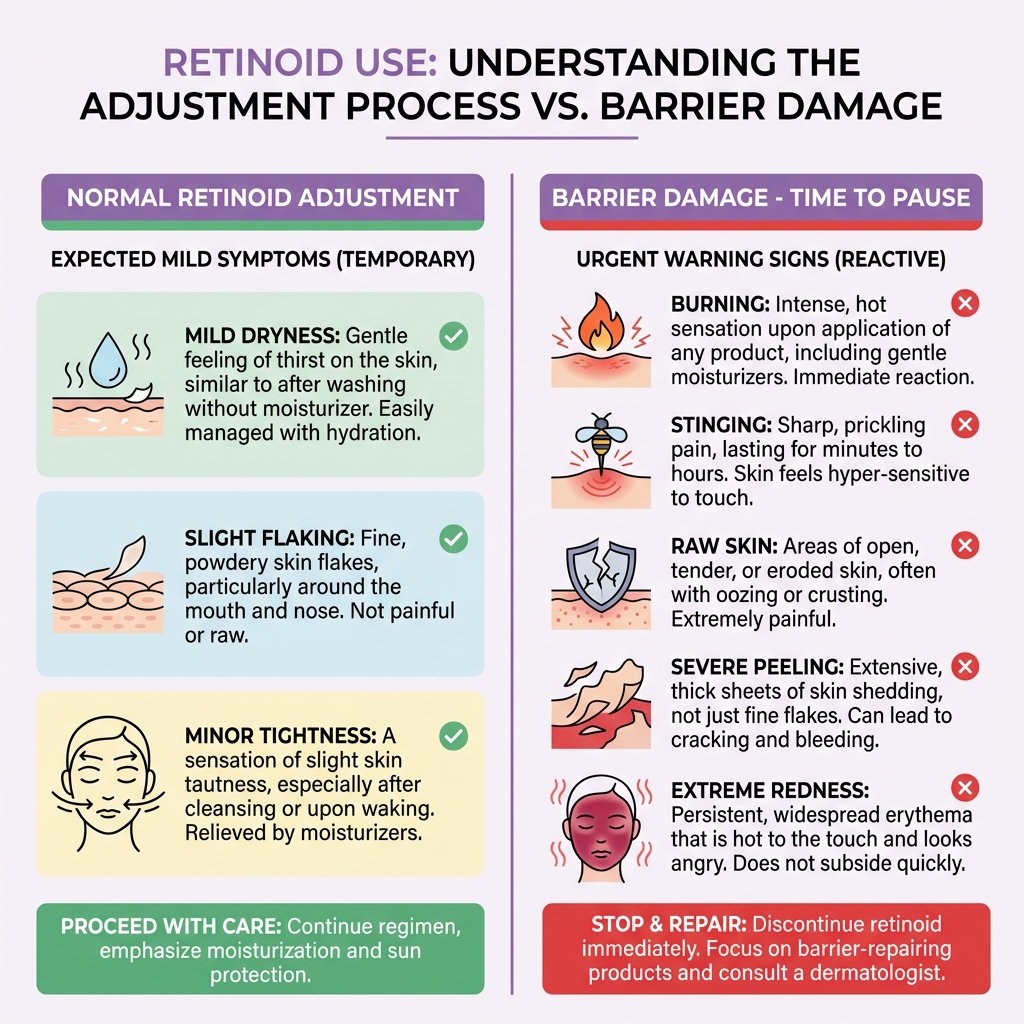
60-Second Self-Check: Normal Adjustment or Barrier Damage?
Signs of NORMAL ADJUSTMENT (keep going, but maybe slow down):
- ☐ Mild dryness that moisturizer fixes
- ☐ Light, powdery flaking—especially around nose and mouth
- ☐ Slight tightness after washing (resolves with moisturizer)
- ☐ Skin looks a bit dull temporarily
- ☐ Symptoms improve with buffering/less frequent use
Signs of BARRIER DAMAGE (stop immediately and repair):
- ☐ Burning or stinging when applying any product—even moisturizer
- ☐ Skin feels raw, tender, or painful to touch
- ☐ Severe, sheet-like peeling or cracking
- ☐ Persistent redness that doesn’t calm down
- ☐ Skin looks shiny/tight in a “plastic” way
- ☐ Products you normally tolerate now cause irritation
Mostly left column? Your skin is adjusting normally. Buffer more, use less frequently.
Even one item in the right column? Your barrier is compromised. Stop the retinoid and repair.
Why Retinoid Irritation Happens
The Skin Barrier Basics
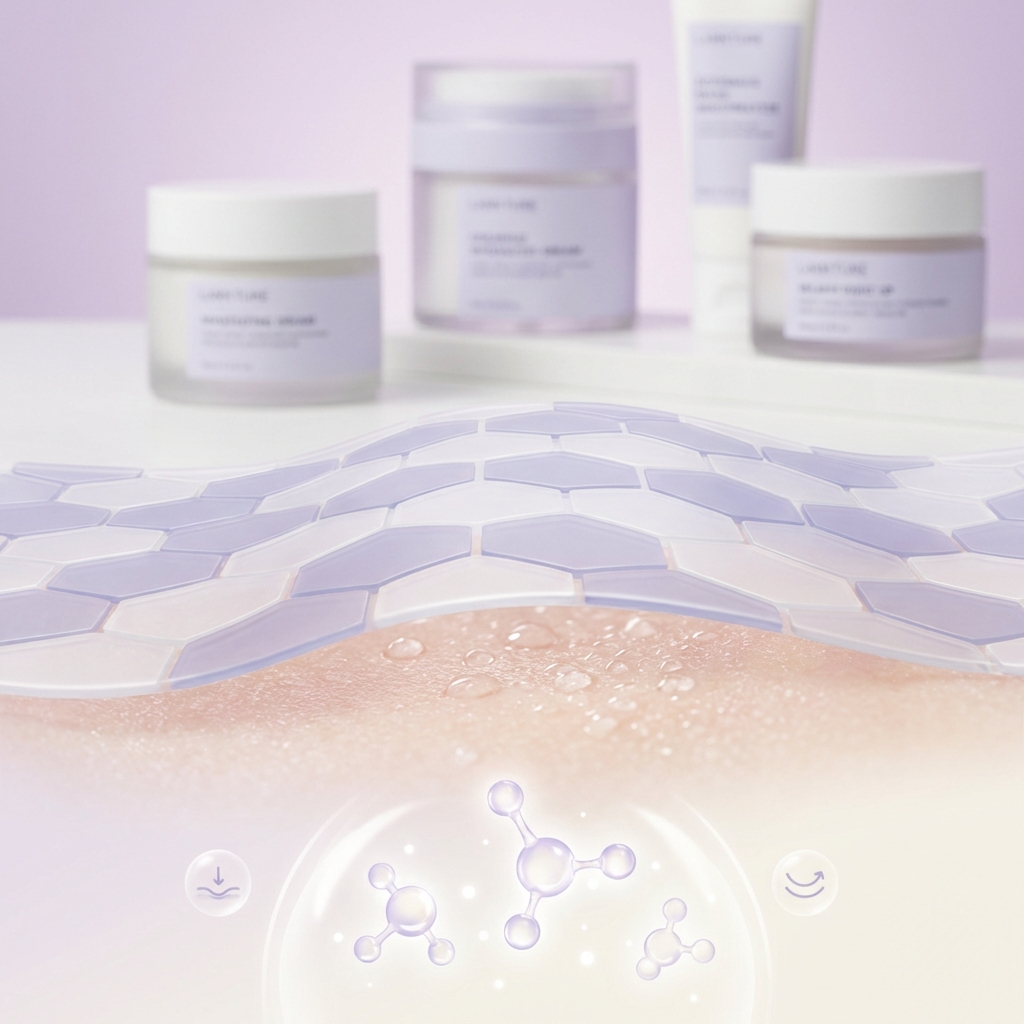
Your skin barrier is the outermost layer—a mix of dead skin cells and lipids (ceramides, cholesterol, fatty acids) that keeps moisture in and irritants out.
Retinoids increase cell turnover. New cells push to the surface faster than normal. This is good—it’s how retinoids smooth texture, clear acne, and fade spots.
But if turnover outpaces your barrier’s ability to rebuild, you lose protection. Water escapes, irritants penetrate, and everything stings.
Common Causes of Barrier Damage
1. Too much, too fast
The #1 cause. Starting with nightly use, high percentages, or applying to damp skin accelerates penetration beyond what your barrier can handle.
2. Not enough moisture
Retinoids are drying. If you skip moisturizer or use one that’s too light, your barrier can’t keep up.
3. Combining with other actives
Using AHAs, BHAs, vitamin C, or benzoyl peroxide at the same time multiplies irritation. Your barrier gets hit from multiple directions.
4. Environmental factors
Winter air, air conditioning, hot showers, and harsh cleansers strip moisture from already-stressed skin.
The 7-Day Barrier Repair Protocol
Your skin barrier takes 7-14 days to rebuild when you stop the damage. Here’s exactly what to do:
Days 1-3: Full Stop + Hydration Flood
Morning:
- Splash with lukewarm water only (no cleanser)
- Apply hydrating serum or toner (hyaluronic acid, glycerin)
- Apply thick moisturizer while skin is damp
- SPF 30+ mineral sunscreen
Evening:
- Gentle, cream-based cleanser (no foam, no gel)
- Hydrating serum/toner
- Rich moisturizer (look for ceramides, cholesterol, fatty acids)
- Optional: thin layer of occlusive (petrolatum, Aquaphor) on driest areas
No retinoids. No exfoliants. No actives. Just cleanser, moisturizer, and SPF. Nothing else.
Days 4-7: Continue + Assess
Keep the same minimal routine. By day 4-5, the burning/stinging should decrease. By day 7, moisturizer should feel comfortable—not painful.
Signs you’re healing:
- Moisturizer no longer stings
- Skin feels less tight throughout the day
- Redness is calming
- Peeling has slowed or stopped
If still stinging at day 7: Continue the repair routine. Some barrier damage needs 14+ days.
Days 8-14: Gradual Texture Return
As your barrier strengthens:
- Skin holds moisture better
- Products absorb without stinging
- Natural texture returns (not that “plastic” look)
- You feel ready to cautiously restart
When to Restart Your Retinoid
Only restart when ALL of these are true:
- Moisturizer applies without any stinging or burning
- Skin no longer feels raw or tender
- The “plastic” tight look is gone
- You’ve had 2-3 days of completely calm skin
The Safer Restart Protocol
Week 1: Once only. Apply after a thick layer of moisturizer (sandwich method). Less is more—pea size for entire face.
Week 2: If no irritation, try twice (3 days apart). Keep buffering.
Week 3+: Slowly increase to every 3rd night, then every other night.
Goal: Build to 3-4 nights/week with no irritation. That’s sustainable long-term.
Never go back to daily use right away. Your barrier remembers—it takes months to truly build tolerance. Rushing the restart just repeats the damage cycle.
Barrier-Repair Routine (AM/PM)
AM Routine
| Step | Purpose | Notes |
|---|---|---|
| 1. Lukewarm water splash | Gentle cleanse | Avoid hot water |
| 2. Hydrating toner/serum | Attract moisture | Hyaluronic acid, glycerin |
| 3. Rich moisturizer | Seal moisture | Ceramides, cholesterol, fatty acids |
| 4. SPF 30+ mineral | Protect | Zinc oxide is gentle |
PM Routine
| Step | Purpose | Notes |
|---|---|---|
| 1. Cream cleanser | Remove SPF gently | No foam, no scrubs |
| 2. Hydrating toner/serum | Moisture base | While skin is damp |
| 3. Rich moisturizer | Repair overnight | Heavy is fine |
| 4. Optional occlusive | Lock everything in | Aquaphor, petrolatum on dry spots |
Common Mistakes
1. Pushing Through Barrier Damage
“It’s supposed to be uncomfortable” is bad advice when your barrier is damaged. Continuing causes more damage, extends recovery, and can lead to:
- Increased sensitivity long-term
- Post-inflammatory hyperpigmentation
- Scarring from constant irritation
Know the difference: Adjustment = annoying. Barrier damage = painful.
2. Using “Repair” Products with Actives
Some “barrier repair” products contain niacinamide, alpha arbutin, or other actives. These are fine for healthy skin but can irritate damaged barriers.
Stick to true basics: Cleanser, moisturizer, SPF. Nothing clever.
3. Skipping Sunscreen
Damaged barriers = increased UV sensitivity. Skipping SPF invites hyperpigmentation and delays healing.
No exceptions. Mineral SPF is gentlest.
4. Restarting Too Soon
Day 5 feels better, so you apply retinoid again. Next morning: back to square one.
Wait the full 7-14 days. Confirm with the “moisturizer doesn’t sting” test before restarting.
5. Returning to Old Routine
If your previous routine caused damage, repeating it causes damage again.
Change something: Less frequency, more buffering, lower percentage, or different retinoid entirely.
FAQ
How do I know if it’s purging or irritation?
Purging: Breakouts only, in your usual acne zones, no overall skin distress.
Irritation: Burning, stinging, redness, peeling—your entire skin is unhappy, not just pimples.
Purging is acne. Irritation is barrier damage. Different problems, different solutions.
See: Retinoid Purging vs Breakout
Can I use anything else during barrier repair?
Only if it’s truly inert. Some safe additions:
- Centella/cica products (if you’ve used them before with no issues)
- Squalane oil (pure, no additives)
- Thermal spring water sprays
Avoid anything new or “active.” Your skin can’t handle introductions right now.
My dermatologist told me to push through—should I?
Some derms expect mild discomfort. But “mild discomfort” means dryness and flaking—not burning and raw skin.
If your eyes water when you apply moisturizer, that’s beyond normal. It’s okay to pause, repair, and restart slower.
Will I lose my retinoid progress if I stop?
No. Cell turnover returns to baseline over weeks, not days. A 7-14 day break preserves most of your progress.
What does lose progress: pushing through damage until your skin can’t tolerate retinoids at all.
Is my retinoid too strong?
Maybe. Signs you need a lower strength:
- Damage happens even with 2x/week use + buffering
- Recovery takes 2+ weeks
- Repeated cycles of damage despite going slowly
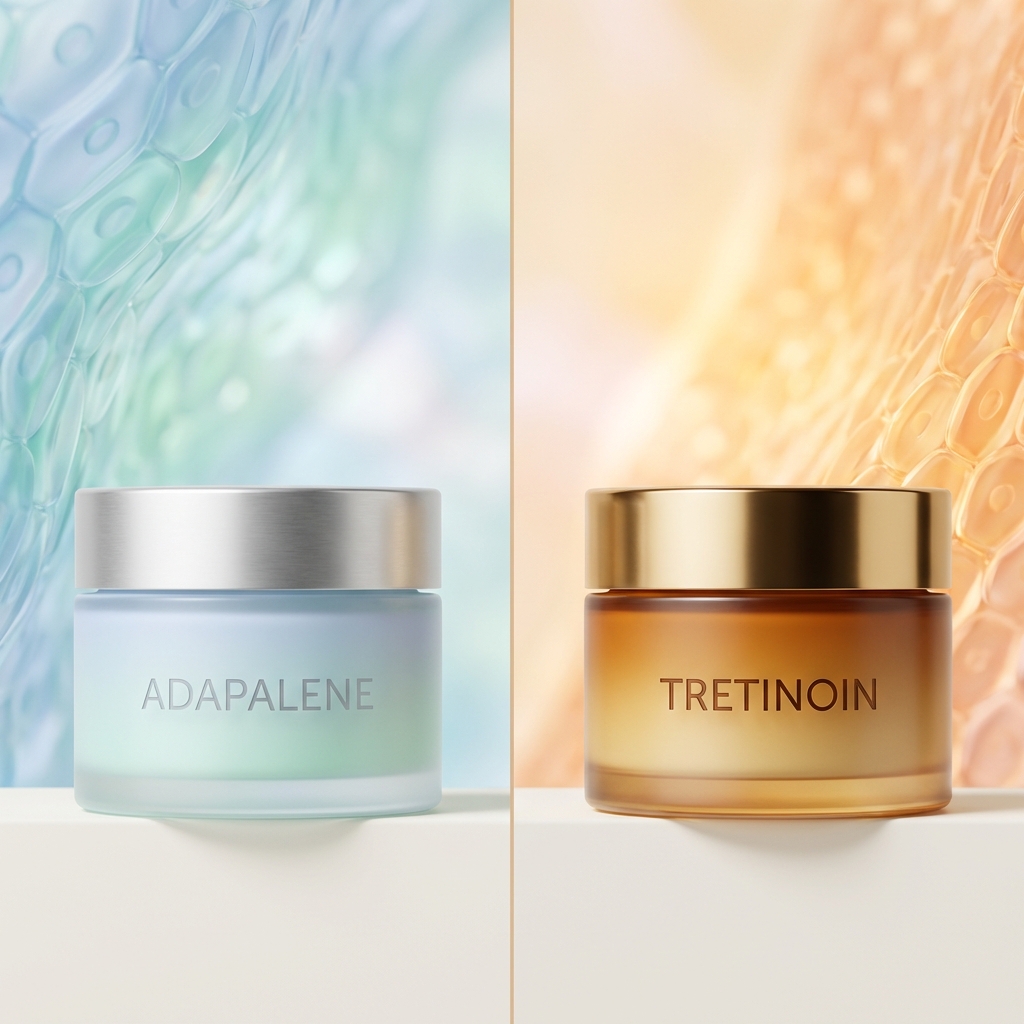
Consider: tretinoin 0.025% instead of 0.05%, or adapalene instead of tretinoin.
Can I switch to a different retinoid?
Yes, after your barrier heals. Options from gentlest to strongest:
- Retinyl palmitate/propionate (very gentle, slow)
- Retinol 0.3-0.5% (OTC, moderate)
- Retinaldehyde (one step from retinoic acid, effective)
- Adapalene (prescription-strength, but less irritating than tretinoin)
- Tretinoin (strongest, most irritating)
The Bottom Line
Retinoid irritation is common but not normal when it crosses into barrier damage. Know the difference:
- Mild dryness/flaking = normal adjustment → buffer more, slow down
- Burning/stinging/raw skin = barrier damage → stop, repair 7-14 days, restart carefully
Your skin barrier needs time to rebuild. Rushing creates repeat damage cycles that extend your timeline far longer than a simple 2-week break.
Track your recovery: Get the app and log daily skin condition to know exactly when you’re ready to restart.
What to Read Next
- Start here: Retinoids Guide
- Was it purging instead? Retinoid Purging vs Breakout
- Starting fresh? Tretinoin: How to Start
- Need a gentler option? Adapalene: How to Start
- Get your personalized routine: Scan your skin with skncoach
This content is for informational purposes only and does not replace professional medical advice. If irritation is severe, spreads, or doesn’t improve with barrier repair, consult a dermatologist.