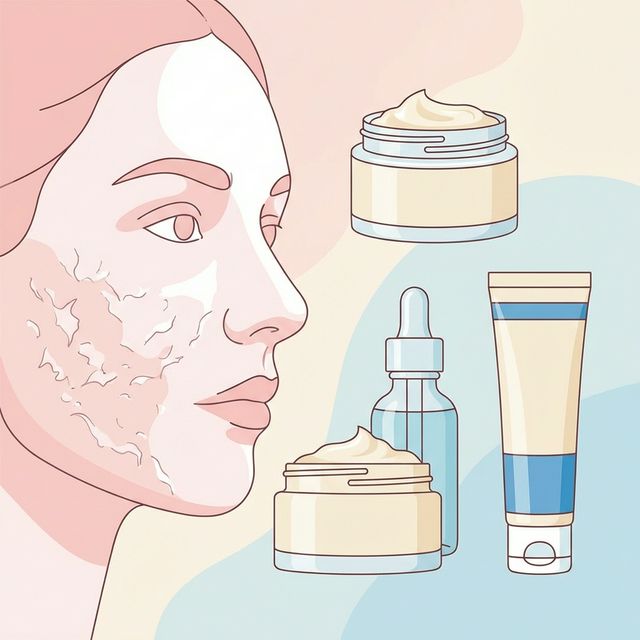
You started your retinoid, and now your face looks like a snake shedding its skin. Is this supposed to happen? Should you push through or stop?
Here’s the truth: some peeling is normal—but there’s a line. Here’s how to tell where you are.
At a Glance
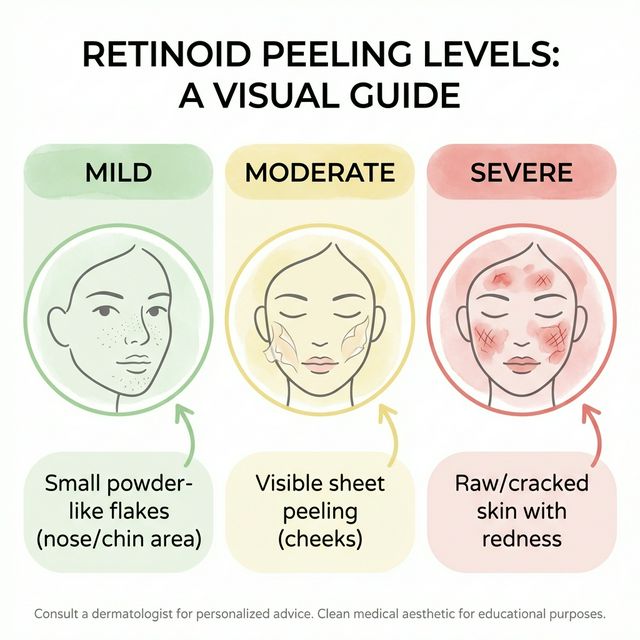
- Mild flaking (powder-like): Normal adjustment—keep going with extra moisture
- Moderate peeling (sheet-like): Yellow flag—reduce frequency, add buffering
- Severe peeling + burning: Stop immediately—barrier is damaged
- Timeline: Adjustment peeling peaks at weeks 2-4, resolves by week 6-8
- Key test: Does moisturizer sting? If yes, that’s barrier damage, not normal peeling.
This is part of our complete Retinoids Guide.
60-Second Self-Check: Where Are You?
MILD (Green Light—Continue):
- ☐ Small, powder-like flakes around nose, chin, or mouth
- ☐ Skin feels slightly dry but not tight
- ☐ Moisturizer absorbs without stinging
- ☐ Peeling is cosmetically annoying but not painful
- ☐ You’re in weeks 1-4 of starting or increasing dose
MODERATE (Yellow Light—Adjust):
- ☐ Larger flakes or visible sheet peeling on cheeks
- ☐ Skin feels tight between applications
- ☐ Makeup looks patchy or doesn’t sit well
- ☐ Some areas are pink/red after application
- ☐ Peeling persists beyond week 4-5
SEVERE (Red Light—Stop):
- ☐ Skin feels raw, tender, or painful to touch
- ☐ Moisturizer causes stinging or burning
- ☐ Deep cracks or fissures, especially around mouth
- ☐ Persistent redness that doesn’t fade
- ☐ Peeling exposes shiny, “wet-looking” skin underneath
Mostly green? Keep your routine, add moisture strategies below.
Yellow territory? Time to dial back—see adjustment protocol.
Even one red? Full stop needed—your barrier is compromised.
Why Retinoids Cause Peeling
The Science
Retinoids accelerate cell turnover. In normal skin, cells take about 28 days to migrate from the base layer to the surface and shed. Retinoids speed this to 14-21 days.
The result: new cells pile up faster than old ones fall off. Your skin literally can’t keep up with the shedding—hence the flakes.
This is temporary. Your skin adapts over 6-8 weeks as cell production and shedding rates synchronize again. The peeling phase is awkward, but it’s also proof the retinoid is working.
Why Some People Peel More
- Tretinoin > adapalene > retinol: Stronger = more turnover = more peeling
- Higher percentages: 0.05% tretinoin peels more than 0.025%
- Dry skin baseline: Less natural oil means less protection
- Climate factors: Cold, dry air accelerates moisture loss
- Other actives: AHAs/BHAs compound the exfoliation
What to Do at Each Stage
Mild Peeling Protocol
Goal: Support skin through normal adjustment without stopping treatment.
Daytime:
- Skip AM cleanser—water only
- Hydrating serum (hyaluronic acid, glycerin)
- Rich moisturizer while skin is damp
- SPF 30+ (mineral is gentler)
Retinoid Nights:
- Gentle cream cleanser
- Wait 10-15 minutes for skin to fully dry
- Apply retinoid (pea-sized for full face)
- Wait 20 minutes
- Layer rich moisturizer on top
Pro tip: Adding a facial oil (squalane, rosehip) after moisturizer can help seal in hydration and soften flakes overnight.
Moderate Peeling Protocol
Goal: Slow down to prevent crossing into barrier damage.
Changes to make:
-
Reduce frequency immediately — If using every other night, switch to 2x/week. If using nightly, switch to every 3rd night.
-
Add buffering — Apply moisturizer before retinoid (sandwich method). Wait 10 minutes between layers.
-
Upgrade your moisturizer — Look for barrier-repair ingredients: ceramides, cholesterol, fatty acids, squalane.
-
Skip the cleanser morning after — Just splash with lukewarm water.
-
Consider short-contact therapy — Apply retinoid for 30-60 minutes, then wash off. This reduces exposure while maintaining some benefit.
When to re-escalate: Only after 2 weeks with no peeling. Increase by one night per week maximum.
Severe Peeling Protocol
Goal: Stop damage and repair before resuming.
This isn’t adjustment anymore—it’s barrier damage. See Retinoid Irritation & Barrier Repair for the full protocol.
Immediate actions:
- Stop all retinoids — No exceptions, even if “it’s almost healed”
- Stop all actives — No AHAs, BHAs, vitamin C, niacinamide
- Minimal routine only — Gentle cleanser + barrier repair moisturizer + mineral SPF
- Add occlusives — Petrolatum or Aquaphor on worst areas overnight
Timeline: 7-14 days minimum before considering restart. Only resume when moisturizer applies without any stinging.
The FLAKE Fix Checklist
Use this troubleshooting system when peeling appears:
F — Frequency check Are you using too often? Cut back by 1-2 nights/week.
L — Layering check Are you buffering? Add moisturizer before retinoid.
A — Amount check Are you using too much? Pea-size for entire face, spread thin.
K — Kind check Is your retinoid too strong? Consider stepping down strength.
E — Environment check Is it winter/dry climate? Add humidifier, occlusive products.
Address these one at a time. Give each change 1-2 weeks before adding another.
Starter Routine for Peeling-Prone Skin
Retinoid Nights (2x/week to start)
| Step | Product | Notes |
|---|---|---|
| 1. Cleanse | Cream or milk cleanser | No foam, no scrubbing |
| 2. Wait | 15-20 minutes | Skin must be completely dry |
| 3. Buffer | Thin moisturizer layer | Wait 10 min to absorb |
| 4. Retinoid | Pea-size, full face | Avoid eyes, lips, nostrils |
| 5. Seal | Rich moisturizer or facial oil | Lock everything in |
Every Morning (Non-Negotiable)
| Step | Product | Notes |
|---|---|---|
| 1. Splash | Lukewarm water only | No cleanser |
| 2. Damp-apply | Hydrating serum | HA, glycerin, etc. |
| 3. Seal | Rich moisturizer | While still tacky |
| 4. Protect | SPF 30+ daily | You’re photosensitive now |
Common Mistakes
1. Scrubbing Off Flakes
Physically removing peeling skin feels satisfying but damages the fresh cells underneath. You’ll peel more, not less.
Fix: Let flakes fall naturally. Gentle cleansing only—no scrubs, no washcloths, no picking.
2. Skipping Moisturizer to “Let Skin Breathe”
Removing moisture accelerates water loss from already-compromised skin. Peeling gets worse.
Fix: More moisture, not less. Damp-apply method. Layer products.
3. Adding Exfoliants to “Help”
AHAs, BHAs, or enzyme masks on peeling skin is like pouring salt on a wound.
Fix: Zero additional exfoliation while adjusting to retinoid. Even weeks after peeling stops, reintroduce slowly.
4. Inconsistent Use
Using retinoid inconsistently (skip a week when peeling, then resume nightly) restarts the adjustment cycle every time.
Fix: Low and slow beats high and erratic. Better to use 2x/week consistently than cycle between daily use and breaks.
5. Ignoring Severity Escalation
Mild peeling that becomes moderate, then severe, is a trajectory—not random. Don’t wait for it to “stabilize.”
Fix: If peeling is getting progressively worse despite 2-3 weeks of adjustment, something is wrong. Reduce or stop.
FAQ
How long does retinoid peeling last?
For most people: 2-6 weeks, peaking around weeks 2-4. By week 6-8, your skin has adapted and peeling should be minimal to none. If you’re still peeling significantly at week 8, you’re likely using too much, too often, or too strong.
Is peeling a sign the retinoid is working?
Partially yes. Peeling indicates accelerated cell turnover, which is the mechanism behind retinoid benefits. But the therapeutic effect doesn’t require visible peeling—many people adapt without ever shedding noticeably.
Can I wear makeup over peeling skin?
You can, but it may look patchy. Tips:
- Apply hydrating primer to smooth texture
- Use cream/liquid products (powder clings to flakes)
- Skip heavy full-coverage—it emphasizes texture
- Setting spray can help blend edges
Should I exfoliate the flakes off?
No chemical or physical exfoliation. The only exception: very gentle enzyme mask (papaya, pumpkin) once weekly if you must—but even this isn’t recommended during active adjustment.
Will the peeling come back if I increase strength?
Often yes. Moving from 0.025% to 0.05% tretinoin, or from retinol to tretinoin, typically triggers a new (usually shorter) adjustment period. Apply the same protocols: reduce frequency at first, buffer, increase moisture.
Is it safe to use retinoid on already peeling skin?
If the peeling is mild (green light), yes—with buffering. If moderate or severe, no. Give your skin time to recover before the next application. Applying retinoid to raw, cracked, or stinging skin guarantees worse damage.
The Bottom Line
Retinoid peeling is normal, temporary, and manageable—if you respond correctly:
- Mild flaking = normal adjustment → add moisture, continue treatment
- Moderate peeling = yellow flag → reduce frequency, add buffering
- Severe peeling + burning = barrier damage → stop and repair
The goal isn’t to avoid all peeling—it’s to keep it in the “mild” zone while your skin adapts. Go slow, support your barrier, and you’ll come out the other side with the clear, smooth skin retinoids are famous for.
Want to track your adjustment? Get the app and log your skin condition daily so you can see patterns and know exactly when you’ve adapted.
What to Read Next
- Start here: Retinoids Guide
- Already crossed the line? Retinoid Irritation & Barrier Repair
- Reduce irritation: Retinol Buffering (Sandwich Method)
- Is it purging? Retinoid Purging vs Breakout
- Get your personalized routine: Scan your skin with skncoach
This content is for informational purposes only and does not replace professional medical advice. If peeling is severe, spreading, or accompanied by pain, consult a dermatologist.