Niacinamide appears in moisturizers, serums and sunscreens. If you have rosacea, the useful question is whether a particular product has a purpose in your routine and feels comfortable. The ingredient name alone cannot answer that.
Niacinamide is optional. There is no concentration range that guarantees a product will suit every person with rosacea, and no requirement to add a separate serum if your current care works for you.
At a Glance
- Look at the whole product: Concentration is one detail, not a tolerance test.
- Keep expectations specific: Evidence about one moisturizer does not establish the same benefit for every serum.
- Do not dismiss a reaction: Burning, a rash or worsening redness deserves attention.
- Keep prescribed care separate: Ask your prescriber before changing treatment to fit a cosmetic.
- Skip a fixed schedule: A general article cannot set your recovery or restart date.
Start here: Rosacea and Redness Guide
A Short Check Before Buying
Use these questions to decide what information you need, not to diagnose your skin or pass a readiness test.
- What do I want this product to do?
- Does a product I already use contain niacinamide?
- Is my current routine comfortable, or am I trying to cover up an unexplained reaction?
- Have I recently changed a medicine or several cosmetics?
- Can I follow this product’s directions alongside my treatment instructions?
- Would one comfortable moisturizer be simpler than adding another serum?
If everything stings or symptoms keep worsening, seek advice about the symptoms before experimenting with additional products. That does not mean stopping prescribed care automatically. See Barrier Care for Rosacea.
What the Evidence Can Tell You
Niacinamide, also called nicotinamide, is a form of vitamin B3. A 2005 study of a niacinamide-containing moisturizer enrolled 50 women with rosacea. It assessed a complete moisturizer, with facial use and a treated-versus-untreated forearm comparison, over four weeks.
The published study reported improvements in several measures with a moisturizer containing 2% niacinamide. The study was funded by the manufacturer, and it did not compare every concentration or isolate the ingredient from the rest of the facial formula. Two participants with irritation that began during the washout phase withdrew during treatment.
This is support for considering a particular kind of moisturizing care, not proof of a universal safe percentage, guaranteed redness reduction or a cure for rosacea. The study’s duration is not a deadline for your own results.
A cosmetic moisturizer does not replace a diagnosis or the treatment selected for inflammatory bumps, persistent redness or eye symptoms. Discuss those goals with the professional involved in your care.
Concentration Is Not a Safety Zone
A bottle advertising a high percentage is not automatically a better choice. Equally, a lower percentage does not prove that a whole formula cannot sting or cause a rash. The product base, other ingredients, application and your own skin all matter.
Avoid turning labels such as 2%, 5% or 10% into a ranking that predicts your response. You do not need to work toward a higher concentration. If you already tolerate a product, there is no reason to replace it solely because an online chart says another percentage is ideal.
Can the ingredient list reveal the percentage?
You cannot infer a percentage from niacinamide’s position on the list. Under US cosmetic labeling rules, ingredients generally appear in descending order, with exceptions including ingredients at 1% or less. The list does not supply an exact concentration. If the manufacturer does not state it, do not invent it from the first five ingredients or the bottom half of the label.
Trying an Optional Product
Keep the plan simple enough that you can tell what changed. Read the finished product’s directions and introduce one optional change at a time. Small-area testing can help identify a reaction, but cannot guarantee future tolerance or replace a clinician’s allergy testing. The AAD explains how to test skincare products.
Do not interpret a brief home test as permission to ignore symptoms during normal use. If a cosmetic causes a reaction, stop using it. Persistent, significant or worsening symptoms deserve professional advice; do not push through repeated stinging to finish a trial.
There is no universal weekly escalation plan, mandatory evening slot or fixed pause before trying again. After a substantial reaction, ask what to do next rather than automatically buying a lower-percentage version.
If a Product Stings or Causes Redness
Record the exact product, when you applied it, what else you used and what happened. A useful description is more specific than “my barrier is broken”: burning for a particular period, itching, swelling, a rash or discomfort when washing.
The niacinamide could be relevant, another ingredient could be relevant, or a separate condition could be involved. An ingredient list alone cannot identify the cause. Do not dismiss a reaction as “just the percentage” or keep applying moisturizer over it to make the product tolerable.
Seek urgent help for breathing difficulty or swelling of the lips, tongue or throat. Eye pain, blurred vision or light sensitivity need urgent medical assessment. NHS rosacea guidance explains eye symptoms that need attention.
Niacinamide Is Not the Same as Nicotinic Acid
The NIH Office of Dietary Supplements distinguishes nicotinic acid from nicotinamide. Nicotinic acid in supplements can cause flushing; nicotinamide does not produce that characteristic effect.
That distinction does not make every topical niacinamide product reaction-free. If your face becomes hot or red after a serum, record the reaction and stop the irritating cosmetic. Do not automatically label it a harmless “niacin flush.” Supplements are not a substitute for a rosacea treatment plan.
Where It Fits in an AM/PM Routine
These examples organize skincare, not medicine doses. Follow the instructions for your actual products.
| Time | Practical outline |
|---|---|
| Morning | Gentle cleansing as needed, prescribed care at its directed point, a comfortable moisturizer, and sunscreen before exposure |
| Optional niacinamide product | Use only if it serves a purpose and fits its directions; it may already be part of the moisturizer or sunscreen |
| Evening | Remove sunscreen and makeup gently, use prescribed treatment as directed, and moisturize in the appropriate order |
You do not have to add niacinamide both morning and evening, or avoid every product that contains it because another one does. The practical issue is whether extra layers add value or make reactions harder to interpret. Do not change sunscreen quantity to reduce a cosmetic ingredient exposure; choose another suitable sunscreen instead.
Combining It With Rosacea Treatment
If you use azelaic acid, metronidazole, ivermectin or another medicine, ask how a new cosmetic fits the exact plan. There is no universal rule that an active medicine always goes first or that separating products into morning and evening guarantees tolerance.
Bring the names and instructions to a pharmacist or prescriber. Ask whether a new product is necessary while the treatment is being assessed. Starting Azelaic Acid for Rosacea provides medicine-specific questions.
Common Mistakes
- Shopping for a percentage instead of a purpose. Consider the complete product and what it adds.
- Assuming natural or fragrance-free means reaction-free. Labels help narrow choices but do not diagnose tolerance.
- Adding several new products together. Keep changes traceable.
- Waiting through pain for a promised result. Follow reaction advice and seek help when needed.
- Replacing treatment with a cosmetic. Review treatment goals with your prescriber.
Questions People Ask
Is niacinamide better than vitamin C for rosacea?
There is no universal winner for every person and formula. Either optional cosmetic may be unnecessary. Choose around a clear purpose, current treatment and your response rather than a general claim that one cannot sting.
Does niacinamide belong in every rosacea routine?
No. A routine can be useful without it. Gentle cleansing, a tolerated moisturizer and sun protection can be planned alongside prescribed care. The AAD’s rosacea skincare guidance describes that foundation.
How long should I wait for results?
Decide what you are trying to improve and whether that is a cosmetic goal or a symptom needing treatment. No fixed timeline guarantees a benefit from every product. Worsening symptoms should be reviewed sooner rather than waiting for a marketing deadline.
Keep a Useful Product Record
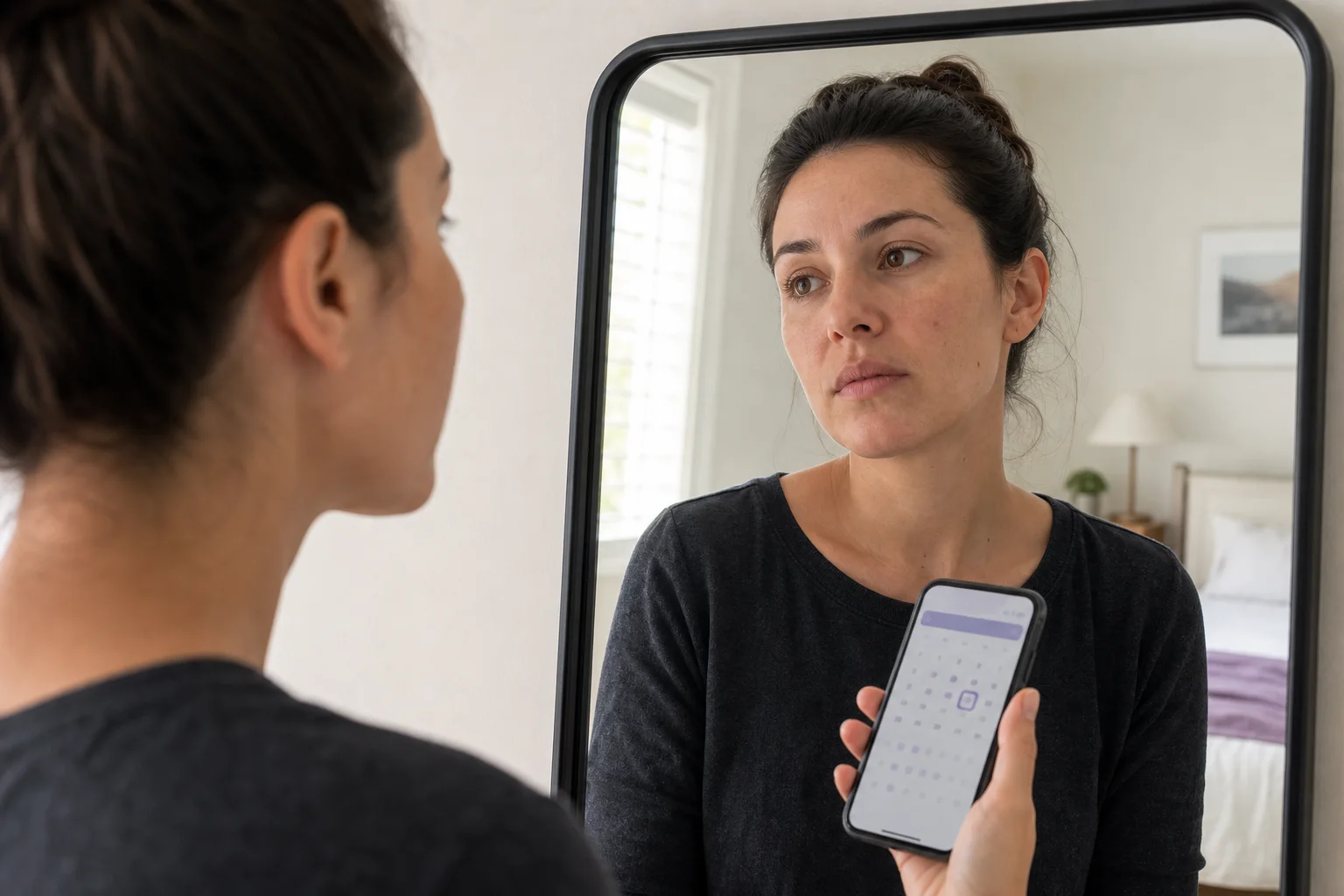
Use skncoach to organize your routine and visible changes. Keep product names and reaction notes together for your own record and appointments. The app cannot diagnose rosacea, identify an allergy or choose a safe concentration for you.
General information, not individual medical advice. Follow your treatment instructions and seek care for significant or persistent symptoms.