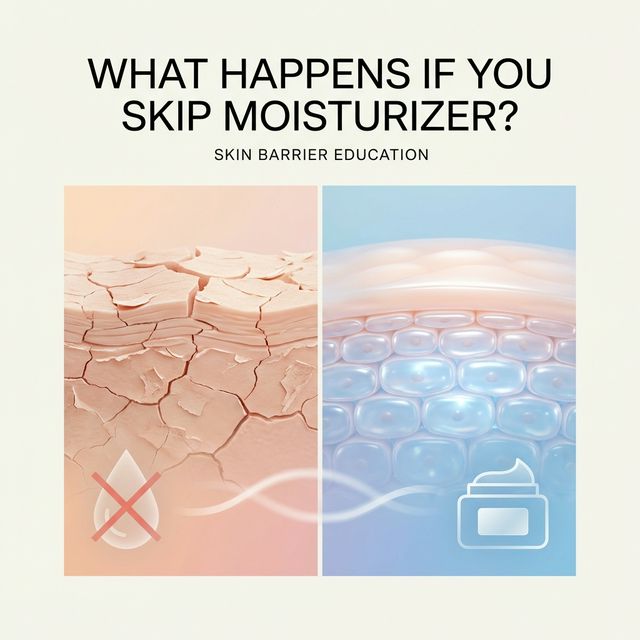
You wash your face and move on. No moisturizer. Maybe your skin feels fine. Maybe you think oily skin doesn’t need one. Maybe you just can’t be bothered.
But your skin notices. And it starts compensating in ways you won’t like. Here’s the chain reaction that happens when you skip moisturizer—and why it matters more than you think.
At a Glance
- Within hours: Barrier loses water → tightness, micro-cracks in outer skin layer
- Within days: Skin overproduces oil to compensate → greasy-but-dehydrated paradox
- Within weeks: Actives sting more, breakouts increase, dullness sets in
- Long term: Accelerated fine lines + chronic sensitivity
- Even oily skin needs moisturizer—skipping makes oiliness worse
Start here → Skin Barrier & Sensitivity Hub — your complete guide to barrier health and hydration.
60-Second Self Check
Which signs do you recognize?
Early warning signs (days without moisturizer):
- Skin feels tight after cleansing
- Subtle flaking around nose or chin
- Makeup sits unevenly or clings to dry patches
- Skin looks dull even after exfoliating
Advanced signs (chronic moisturizer skipper):
- Oily T-zone but cheeks feel dry
- Products that used to work now sting
- Breakouts that won’t clear despite actives
- Fine lines appearing earlier than expected
→ 2+ checks in either group? Your barrier is under-hydrated. Keep reading.
The Domino Effect: What Actually Happens
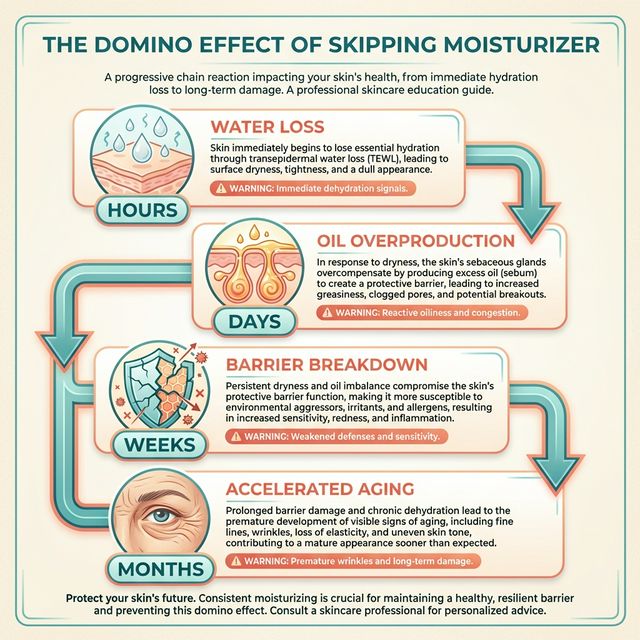
Stage 1: Trans-Epidermal Water Loss (Hours)
Your skin barrier is a wall of lipids (fats) that keeps water in and irritants out. Without moisturizer after cleansing:
- Cleanser strips surface oils — even gentle ones remove some lipids
- Water evaporates unprotected — this is called trans-epidermal water loss (TEWL)
- Outer layer dehydrates — the stratum corneum becomes brittle
What you feel: Tightness, that “squeaky clean” sensation. That tightness isn’t clean—it’s damage.
Stage 2: Oil Overproduction (Days)
Your skin has sensors that detect dehydration. When the barrier dries out:
- Sebaceous glands ramp up — more sebum to compensate for lost moisture
- Oil increases but water stays low — skin becomes oily AND dehydrated
- Pores appear larger — excess oil mixed with dead skin stretches them
The oily-skin trap: If you skip moisturizer because you’re oily, you trigger more oil. This is the #1 reason people with oily skin can’t get it under control.
Stage 3: Barrier Breakdown (Weeks)
Chronic under-hydration weakens the barrier structurally:
- Ceramide production drops — the lipids that hold skin cells together decline
- Micro-cracks form — irritants, bacteria, and allergens get in
- Inflammation increases — immune response triggers redness and sensitivity
- Actives penetrate too deep — retinoids and acids burn instead of treat
What you see: Products sting, breakouts increase, skin looks perpetually dull.
Stage 4: Accelerated Aging (Months to Years)
Long-term dehydration has consequences that go beyond surface problems:
- Collagen breaks down faster — dehydrated skin has higher oxidative stress
- Fine lines deepen — expression lines become permanent without plump, hydrated skin
- Hyperpigmentation worsens — damaged barrier = more UV damage = more dark spots
- Recovery takes longer — everything from acne marks to procedure healing slows down
”But My Skin Type Doesn’t Need It”
Oily Skin
Myth: “Moisturizer makes me more oily.”
Reality: Lightweight, oil-free moisturizers reduce oiliness by telling your sebaceous glands they can relax. Without them, your skin panics and produces more oil.
What to use: Gel or gel-cream moisturizer. Look for: hyaluronic acid, niacinamide, squalane (it’s not oily despite the name).
Acne-Prone Skin
Myth: “Moisturizer clogs my pores.”
Reality: A compromised barrier causes more breakouts. Dehydrated skin traps oil and dead cells in pores. Proper moisturizer reduces acne, not increases it.
What to use: Non-comedogenic, fragrance-free gel moisturizer. Avoid heavy creams, coconut oil, or anything with “buttery” textures.
Young Skin
Myth: “I’m in my 20s, I don’t need moisturizer yet.”
Reality: Prevention is dramatically easier than repair. Starting moisturizer early keeps your barrier strong, delays fine lines, and means actives work better when you add them.
Humid Climate
Myth: “It’s humid, I don’t need to moisturize.”
Reality: Air conditioning, hot showers, and cleansing still strip moisture regardless of outdoor humidity. You may need a lighter formula, but you still need one.
What to Do: Step by Step
If You’ve Been Skipping Moisturizer
Step 1: Start with one basic moisturizer
- Fragrance-free, minimal ingredients
- Apply to slightly damp skin after cleansing
- AM and PM—both times matter
Step 2: Choose the right texture for your skin
| Skin Type | Best Texture | Key Ingredients |
|---|---|---|
| Oily | Gel, gel-cream | Hyaluronic acid, niacinamide |
| Dry | Rich cream | Ceramides, shea butter, squalane |
| Combination | Lightweight lotion | Ceramides, hyaluronic acid |
| Sensitive | Simple cream | Ceramides, panthenol, centella |
Step 3: Give it 2 weeks
- Skin needs time to recalibrate oil production
- You may feel slightly more oily initially—this is normal and temporary
- After 2 weeks, sebum production should normalize
Step 4: Then assess what else you need
- Once the barrier is stable, actives work better and sting less
- Add one product at a time
- Full guide: Moisturizer Ingredients: Ceramides, Cholesterol & Fatty Acids
The Repair Routine
AM Routine (Moisture Reset)
- Gentle cleanser (cream or gel, fragrance-free)
- Moisturizer on damp skin (lock in hydration)
- SPF 30+ on top (protects the healing barrier)
PM Routine (Moisture Reset)
- Oil cleanser or micellar water (removes SPF/makeup)
- Gentle second cleanser if needed
- Hydrating serum (hyaluronic acid, optional)
- Moisturizer—slightly richer than AM if your skin tolerates it
How long: Most people notice less tightness in 3-5 days. Oil normalization takes 2-3 weeks. Full barrier recovery from chronic skipping: 4-6 weeks.
Common Mistakes
1. Choosing the Wrong Moisturizer
Using a heavy cream when you need a gel (or vice versa) creates new problems.
Fix: Match texture to skin type. Start lightweight—you can always upgrade richness.
2. Only Moisturizing When Skin Feels Dry
Waiting for tightness means damage is already happening.
Fix: Moisturize every time you cleanse, even if your skin feels fine. Prevention > repair.
3. Applying to Dry Skin
Moisturizers work best on slightly damp skin—they trap existing moisture.
Fix: Apply within 60 seconds of patting your face dry (leave it slightly damp).
4. Skipping AM Moisturizer Because You Use SPF
Sunscreen is not moisturizer. SPF protects from UV but doesn’t necessarily hydrate.
Fix: Moisturizer first, then sunscreen. Always two separate steps.
5. Replacing Moisturizer with Oils
Facial oils are occlusives—they seal moisture in. But if there’s no moisture to seal, they just sit on dry skin.
Fix: Use oil over moisturizer, or use a moisturizer that contains oils.
FAQ
Do I need moisturizer if I have oily skin?
Yes. Oily skin is not the same as hydrated skin. Your skin can produce excess oil (sebum) while simultaneously lacking water in the outer layer. A lightweight, oil-free gel moisturizer rebalances this by hydrating without adding oil.
Can skipping moisturizer cause acne?
Indirectly, yes. When you skip moisturizer, your barrier weakens, oil production increases, and dead skin cells don’t shed properly—all of which contribute to clogged pores and breakouts. See How to Repair Your Skin Barrier.
What’s the bare minimum skincare routine?
Cleanser + moisturizer + sunscreen. That’s it. If you do nothing else, these three steps protect your barrier. Everything else (serums, actives, treatments) builds on this foundation.
Is there anyone who truly doesn’t need moisturizer?
Very rarely. Some people with extremely oily skin in humid climates may get by with just SPF that has hydrating ingredients. But even then, a lightweight gel moisturizer is usually beneficial.
How do I know my moisturizer is working?
After 2-3 weeks of consistent use: skin feels comfortable (not tight, not greasy), cleansing doesn’t cause stinging, makeup applies smoothly, and you may notice slightly less oil in your T-zone.
The Bottom Line
Moisturizer isn’t optional—it’s the foundation everything else depends on:
- Skipping it triggers a chain reaction: dehydration → oil overproduction → barrier damage → sensitivity → aging
- Every skin type needs it—just in different textures
- It makes everything else work better: actives, sunscreen, even makeup
The simplest upgrade to any skincare routine is consistent moisturizing. Your barrier will thank you.
Want a personalized moisturizer recommendation for your skin type? Start a skin scan for a customized routine.
Related Guides
- Skin Barrier & Sensitivity Hub — your complete barrier health guide
- Moisturizer Ingredients: Ceramides, Cholesterol & Fatty Acids — what makes a good moisturizer
- How to Repair Your Skin Barrier — complete repair guide
This content is for informational purposes only and does not replace professional medical advice. Consult a board-certified dermatologist for personalized treatment recommendations.