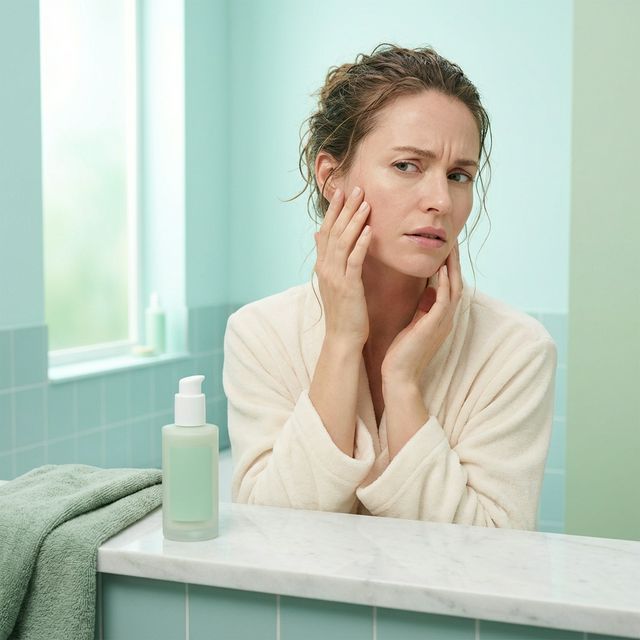
You finish washing your face. Your skin feels tight, dry, almost like it’s shrinking. You assume that means it’s clean.
It doesn’t. That tight feeling is your skin telling you something went wrong — and if you keep ignoring it, the damage compounds. Here’s exactly what’s happening and how to stop it.
At a Glance
- Tightness = stripped barrier — your cleanser removed protective lipids along with dirt
- pH disruption — harsh cleansers push skin from pH 5.5 to 9+, weakening defenses
- Dehydration cascade — water escapes through damaged barrier → dryness, flaking, sensitivity
- Oily rebound — skin overproduces oil to compensate, making things worse
- Fix is simple — switch to a pH-balanced, non-foaming cleanser
Start here → Skin Barrier & Sensitivity Hub — your complete guide to barrier health and hydration.
60-Second Self Check
Which signs do you recognize?
After cleansing:
- Face feels tight or “pulled” within minutes
- Skin looks shiny-tight (not dewy — more like plastic wrap)
- Redness appears on cheeks or around nose
- Products applied afterward sting or tingle
Over time:
- Flaking or peeling, especially around mouth and chin
- Oily T-zone by midday despite feeling dry after washing
- Increased breakouts despite “cleaner” skin
- Fine lines look more pronounced after cleansing
→ 2+ checks in either group? Your cleanser is damaging your barrier. Keep reading.
What’s Actually Happening to Your Skin
Stage 1: Lipid Stripping
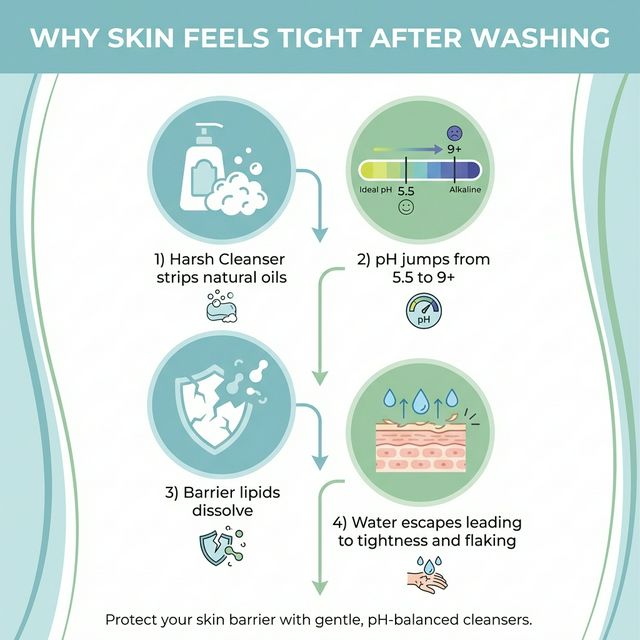
Your skin’s outer layer (stratum corneum) is held together by a mortar of lipids — ceramides, cholesterol, and fatty acids. This lipid barrier keeps water in and irritants out.
Harsh cleansers — especially foaming ones with sulfates — dissolve these lipids along with the dirt and oil you’re trying to remove.
What you feel: Immediate tightness. Your skin literally lost its waterproof seal.
Stage 2: pH Disruption
Healthy skin sits at pH 4.5–5.5 (slightly acidic). This acid mantle:
- Keeps bad bacteria at bay
- Supports the enzymes that repair your barrier
- Maintains the lipid structure
Many cleansers — bar soaps, foaming washes, micellar waters with high surfactant loads — push your skin to pH 8–10. At this pH:
- Barrier enzymes stop working — they need acidic conditions
- Skin swells slightly — intercellular gaps widen
- Beneficial bacteria die off — pathogenic bacteria thrive
What you feel: That “squeaky clean” sensation. It’s your disrupted acid mantle, not cleanliness.
Stage 3: Trans-Epidermal Water Loss (TEWL)
With lipids stripped and pH disrupted, water escapes your skin rapidly:
- Within minutes: Skin dehydrates at the surface
- Within hours: Deeper layers start losing moisture
- Repeated exposure: Chronic dehydration sets in
What you see: Tightness turns to visible dryness, flaking, and dullness.
Stage 4: Compensatory Oil Production
Your skin detects the dehydration and responds the only way it knows how — producing more sebum:
- Sebaceous glands ramp up output
- Oil increases but doesn’t replace lost water
- You get the worst of both worlds: oily AND dehydrated
The cycle: You feel oilier → wash more aggressively → strip more lipids → tightness worsens → more oil. This is why many people with “oily skin” actually have damaged, dehydrated skin underneath.
The Cleanser Culprits
Sulfates (SLS, SLES)
The biggest offenders. Sodium lauryl sulfate and sodium laureth sulfate create rich foam but dissolve barrier lipids aggressively. Found in most drugstore foaming cleansers and bar soaps.
High pH Formulas
Bar soaps typically have pH 9–10. Even “gentle” bar soaps are usually too alkaline for facial skin. Liquid cleansers vary wildly — some are pH 5.5, others pH 8+.
Over-Cleansing
Washing more than twice daily, or cleansing for too long (>60 seconds), strips the barrier regardless of how gentle the product is.
Hot Water
Heat dissolves oils faster. Hot water amplifies the stripping effect of any cleanser.
What to Do: Step by Step
Step 1: Switch Your Cleanser
| Cleanser Type | pH | Foaming? | Barrier Impact |
|---|---|---|---|
| Cream / milk cleanser | 5.0–5.5 | No | ✓ Gentle |
| Gel cleanser (sulfate-free) | 5.0–6.0 | Minimal | ✓ Gentle |
| Micellar water (rinse-off) | 5.5–7.0 | No | ✓ Moderate |
| Foaming cleanser (sulfate-free) | 5.5–6.5 | Yes | ⚠ Check ingredients |
| Foaming cleanser (with SLS) | 7.0–10.0 | Yes | ✗ Strips barrier |
| Bar soap | 9.0–10.0 | Yes | ✗ Strips barrier |
Best choice for tight skin: Cream or gel cleanser, sulfate-free, pH 5.0–5.5.
Step 2: Fix Your Technique
- Lukewarm water only — never hot
- 60 seconds max — enough to cleanse, not enough to strip
- Fingertips, not tools — washcloths, brushes, and sponges add mechanical disruption
- Pat dry — don’t rub with a towel
Step 3: Moisturize Immediately
Apply moisturizer within 60 seconds of cleansing, while skin is still slightly damp. This locks in residual moisture before it evaporates.
Key ingredients to look for:
- Ceramides — directly replenish stripped lipids
- Hyaluronic acid — pulls water into dehydrated skin
- Niacinamide — strengthens barrier, regulates oil
- Panthenol (B5) — soothes and repairs
Step 4: Assess After 2 Weeks
With the right cleanser and technique:
- Days 1-3: Tightness should reduce noticeably
- Week 1: Flaking and redness start improving
- Week 2: Oil production begins normalizing
- Week 4: Barrier should feel significantly healthier
If tightness persists after 2 weeks with a gentle cleanser, the issue may be deeper barrier damage. See How to Repair Your Skin Barrier for the full reset protocol.
The Right Routine
AM Routine (Barrier-Friendly)
- Lukewarm water rinse only (or gentle cream cleanser if needed)
- Moisturizer on damp skin
- SPF 30+ on top
PM Routine (Barrier-Friendly)
- Oil cleanser or micellar water (removes SPF/makeup gently)
- Gentle second cleanser — 60 seconds max
- Moisturizer on slightly damp skin
- Optional: thin layer of occlusive (Vaseline/Aquaphor) on very dry areas
AM skip tip: Many dermatologists recommend skipping cleanser entirely in the morning if your skin trends dry or sensitive. A splash of lukewarm water is enough.
Common Mistakes
1. Choosing Foaming = Effective
Foam doesn’t mean clean. Some of the most effective cleansers produce zero foam. The foaming agent (surfactant) is what strips your barrier.
Fix: Judge a cleanser by how your skin feels afterward, not by how much it lathers.
2. Double Cleansing Too Aggressively
Double cleansing is great for removing SPF and makeup, but if both cleansers are harsh, you’re stripping twice.
Fix: First cleanse = oil/balm (dissolves sunscreen). Second cleanse = gentle, low-pH gel or cream. Total time: under 90 seconds.
3. Using Actives Right After Cleansing Tight Skin
Applying retinoids, AHAs, or vitamin C on freshly stripped skin dramatically increases irritation. Your barrier is already compromised — actives penetrate too deep.
Fix: On nights you use actives, wait 10-15 minutes after cleansing, or buffer with moisturizer first. See How to Introduce Actives Without Irritation.
4. Thinking “Tight = Clean”
This mindset is the root cause. Clean skin should feel comfortable — not tight, not greasy, just neutral. If you feel anything pulling, your cleanser is too harsh.
Fix: Redefine “clean” as: no visible dirt/oil + skin feels comfortable and looks calm.
5. Using Makeup Wipes as Your Only Cleanser
Makeup wipes require rubbing (mechanical irritation) and leave surfactant residue on skin. They’re a convenience tool, not a cleanser.
Fix: Use micellar water on a cotton pad (pressed, not rubbed) followed by a gentle rinse-off cleanser.
FAQ
Is it normal for skin to feel tight after washing?
No. Tightness means your cleanser stripped your barrier’s protective lipids. Healthy post-cleanse skin should feel comfortable — not tight, not greasy. If you feel tightness, your cleanser is too harsh, the water is too hot, or you’re cleansing too long.
Do I need to cleanse in the morning?
Not necessarily. If your skin isn’t very oily, a lukewarm water rinse in the morning is often enough. Over-cleansing is one of the most common causes of chronic tightness and dehydration. Save your gentle cleanser for PM when you actually need to remove sunscreen and dirt.
Can oily skin feel tight after washing?
Absolutely — and it’s a red flag. Oily-but-tight means your barrier is damaged and your skin is producing excess oil to compensate for lost hydration. The fix isn’t a stronger cleanser; it’s a gentler one plus moisturizer. See What Happens If You Skip Moisturizer?.
How do I know if my cleanser’s pH is right?
Most gentle gel and cream cleansers from reputable brands are pH 5.0–6.0. You can check with pH test strips, but the easier test is: if your skin feels comfortable (not tight, not filmy) 5 minutes after rinsing, the pH is likely fine.
What about micellar water — is it gentle enough?
Micellar water is generally gentle, but it depends on the formula. Some contain strong surfactants. The key rule: always rinse micellar water off your face — don’t just wipe and leave it. Surfactant residue left on skin weakens the barrier over time.
The Bottom Line
Tight skin after washing isn’t a sign of cleanliness — it’s a sign of damage:
- Your cleanser is stripping barrier lipids and disrupting your skin’s natural pH
- The fix is straightforward: gentle cleanser + lukewarm water + moisturize on damp skin
- Results are fast: most people notice less tightness within days of switching
Stop chasing the “squeaky clean” feeling. Your skin will be healthier, calmer, and actually cleaner without it.
Want to know if your current routine is helping or hurting your barrier? Start a skin scan for a personalized assessment.
Related Guides
- Skin Barrier & Sensitivity Hub — your complete barrier health guide
- What Happens If You Skip Moisturizer? — the consequences of under-hydrating
- How to Repair Your Skin Barrier — complete repair guide
This content is for informational purposes only and does not replace professional medical advice. Consult a board-certified dermatologist for personalized treatment recommendations.