You’ve got the cleanser, the serums, the moisturizer, the SPF. You’re following the routine. So why is your skin still breaking out?
Here’s the uncomfortable truth: for most people, breakouts aren’t caused by missing a product — they’re caused by something you’re already doing. The harder you try, the worse it gets. Your routine is fighting your skin instead of supporting it.
This guide walks through the 10 most common skincare mistakes that dermatologists see causing breakouts — and exactly what to change. Think of it as a routine audit: find your mistake, apply the fix, and let your skin recover.
At a Glance
- Most breakouts come from routine mistakes — not missing products
- Over-doing it is more common than under-doing it — too many actives, too much cleansing, too frequent product swaps
- Your skin needs 6–8 weeks to respond to a consistent routine — stop switching before then
- Non-product factors matter enormously — pillowcases, phones, touching your face
- When in doubt, subtract — remove the newest product and simplify
Start here → Routine Order & Layering Hub — your complete guide to building, ordering, and troubleshooting skincare routines.
60-Second Self Check
How many of these apply to you right now?
Your routine habits:
- You wash your face more than twice a day
- You use multiple actives (acids, retinoids, vitamin C) in the same routine
- You’ve introduced 2+ new products in the last month
- You switch products before giving them 6 weeks
- You skip moisturizer because your skin feels oily
Your daily habits:
- You touch your face throughout the day
- You haven’t changed your pillowcase in over 3 days
- You pop or pick at pimples when they appear
- You sleep in your makeup or skip double cleansing after SPF
- You don’t know if your products are comedogenic
→ 3+ checks? You’ve found your breakout triggers. Read through the mistakes below to find your specific fixes.
The 10 Mistakes — And Exactly How to Fix Them
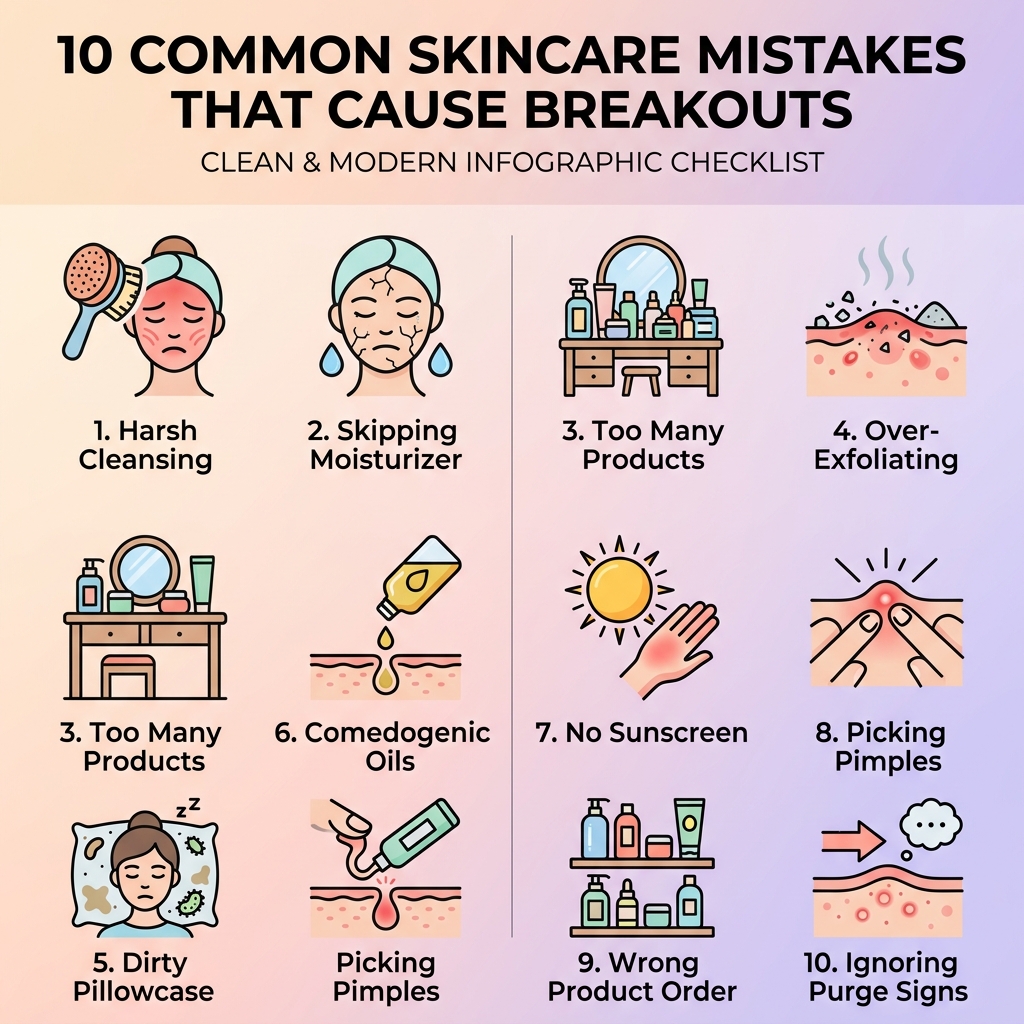
Mistake 1: Over-Cleansing or Scrubbing Too Hard
What’s happening: You wash your face 3+ times a day, use foaming cleansers with sulfates (SLS/SLES), or scrub with harsh physical exfoliants. Your skin feels “squeaky clean” — which actually means you’ve stripped the acid mantle.
Why it causes breakouts: Aggressive cleansing destroys the skin’s natural barrier. Your skin responds by overproducing sebum to compensate for the lost oils. More oil = more clogged pores = more breakouts. Research shows that over-cleansing increases transepidermal water loss (TEWL) by up to 25%, leaving skin both dehydrated and oily.
The fix:
- Cleanse twice daily maximum — AM and PM
- Use a gentle, non-foaming or low-foam cleanser (pH 5.0–6.0)
- Massage for 60 seconds with fingertips — no washcloths, no scrub brushes
- Lukewarm water only — hot water strips oils further
The 60-second rule. Massage cleanser gently for a full 60 seconds — most people rush through in 10–15 seconds. This gives surfactants time to dissolve oil and debris without needing to scrub harder.
See also: Why Skin Feels Tight After Washing — if your face feels tight post-cleanse, your cleanser is too harsh.
Mistake 2: Skipping Moisturizer Because Your Skin Is Oily
What’s happening: Your skin produces excess oil, so you skip moisturizer thinking it’ll make things worse. Or you use a mattifying toner to “dry out” the oil. The logic seems sound — but it backfires consistently.
Why it causes breakouts: Oily skin without moisture is dehydrated oily skin. When the barrier is depleted of water, your sebaceous glands produce even more oil to compensate. The result: more congestion, more clogged pores, more breakouts. It’s counterintuitive, but proven repeatedly in dermatological research.
The fix:
- Use a lightweight, oil-free, gel-based moisturizer — not a heavy cream
- Apply to slightly damp skin right after cleansing
- Look for ingredients like hyaluronic acid, glycerin, or niacinamide
- Your skin’s oil production should begin to normalize within 2–4 weeks
See also: What Happens When You Skip Moisturizer — the full science behind why every skin type needs hydration.
Mistake 3: Introducing Too Many Products at Once
What’s happening: You bought a new cleanser, a vitamin C serum, a retinol, and a new moisturizer — and started using all of them this week. Social media hauls and influencer routines make this feel normal.
Why it causes breakouts: When you introduce multiple products simultaneously, your skin barrier gets overwhelmed. If you break out, you have no idea which product caused it. You might drop the wrong one and keep the culprit. This cycle of add-react-swap is one of the most common patterns dermatologists see.
The fix:
- One new product at a time. Full stop.
- Wait 2–4 weeks before introducing the next product
- If breakouts appear, you know exactly what caused them
- Start with the lowest concentration of any active
| Products Added | Can You Identify the Cause? | Risk Level |
|---|---|---|
| 1 new product | ✅ Yes — clear cause-and-effect | Low |
| 2 new products | ⚠️ Maybe — could be either one | Moderate |
| 3+ new products | ❌ No — impossible to isolate | High |
See also: How to Introduce Actives Without Irritation — the safe introduction protocol.
Mistake 4: Over-Exfoliating
What’s happening: You’re using a BHA cleanser in the morning, an AHA toner at night, a physical scrub twice a week, and a retinoid. Each product seems fine on its own — but the combined exfoliation is destroying your barrier.
Why it causes breakouts: Over-exfoliation strips away the protective outer layer of skin, exposing the vulnerable layers beneath. This triggers inflammation, redness, and — paradoxically — more breakouts. A compromised barrier can’t fight bacteria effectively, and the inflammation itself causes new acne lesions.
The fix:
- Audit your total exfoliation load. Count every product that exfoliates: AHAs, BHAs, retinoids, enzymes, physical scrubs
- Most skin can handle 1–2 exfoliating products max, used 2–3 times per week total
- If your skin is red, tight, or stinging: stop all actives and repair with a simple cleanser + moisturizer routine for 2 weeks
Signs you’ve over-exfoliated: Skin feels tight, burns when applying products, looks shiny/waxy (not dewy), develops tiny bumps or redness that wasn’t there before. See Over-Exfoliated Skin — Barrier Reset for the recovery protocol.
Mistake 5: Using Comedogenic Products Without Knowing It
What’s happening: You’re using products that contain pore-clogging ingredients — and you don’t realize it. This includes skincare, makeup, hair products, and even “natural” or “clean” products marketed as safe for acne-prone skin.
Why it causes breakouts: Comedogenic ingredients physically block pores, trapping oil and dead skin cells beneath the surface. This creates the perfect environment for P. acnes bacteria. Coconut oil (comedogenicity rating 4/5) is one of the most common culprits — despite being one of the most recommended “natural” skincare ingredients on social media.
Common offenders:
- Coconut oil — comedogenicity 4/5
- Cocoa butter — comedogenicity 4/5
- Isopropyl myristate — comedogenicity 5/5 (found in many moisturizers)
- Lanolin — comedogenicity 1–2/5 (but sensitizing for many)
- Heavy silicones — some can trap debris under a film
- Hair products — conditioner, styling products, and oils drip onto forehead and jawline
The fix:
- Check ingredient lists against a comedogenicity database before buying
- Pay special attention to hairline and jawline breakouts — these are often caused by hair products
- “Natural” and “clean” labels don’t mean non-comedogenic
- When in doubt, look for products labeled “non-comedogenic” and “oil-free”
Mistake 6: Changing Products Every 2 Weeks
What’s happening: You try a new serum for 10 days, don’t see results, decide it’s not working, and switch to something else. Repeat indefinitely.
Why it causes breakouts: Your skin’s cell turnover cycle takes 28–40 days. Most skincare products need a full cycle — often two — to show visible results. The AAD recommends waiting 6–8 weeks before judging whether a product works, and up to 3–4 months for significant clearing of acne. Switching before that means nothing gets a fair shot, and the constant introduction of new products stresses your barrier.
The fix:
- Commit to a product for at least 6 weeks before judging results
- Take photos in the same lighting once a week to track progress you can’t see day-to-day
- The exception: if a product causes immediate stinging, burning, or a rash, stop using it right away
- Keep a simple skincare journal — product name, start date, skin notes
The photo trick. Take a photo every Sunday morning in the same spot with the same lighting. Progress is nearly invisible day-to-day but obvious over 4–6 weeks. This single habit prevents 90% of premature product-switching.
Mistake 7: Only Spot-Treating Pimples
What’s happening: You apply benzoyl peroxide or salicylic acid only on visible pimples — and nowhere else.
Why it causes breakouts: By the time a pimple is visible on the surface, it started forming 2–4 weeks ago deep in the pore. Spot treatment only addresses what you can see right now. The AAD specifically recommends applying acne treatment across the entire acne-prone area — not just on individual pimples — to prevent new breakouts from forming beneath the surface.
The fix:
- Apply acne treatments (BHA, benzoyl peroxide, adapalene) as a thin layer across the entire area where you typically break out
- Continue even when skin looks clear — acne is forming beneath the surface before it’s visible
- Spot treatment is fine as a supplement, but shouldn’t be your entire strategy
- Use the lowest effective concentration spread evenly rather than a high concentration on one spot
Mistake 8: Poor Hygiene Habits (Pillowcases, Phone, Touching)
What’s happening: You have a perfect skincare routine — but you sleep on the same pillowcase for two weeks, press your phone against your cheek for calls, and rest your chin on your hands throughout the day.
Why it causes breakouts: Your pillowcase accumulates bacteria, dead skin cells, oil, sweat, and product residue every night. Your phone screen is covered in bacteria from every surface you’ve touched. Your hands transfer oil, bacteria, and dirt directly to your pores. These non-product factors are some of the most overlooked breakout triggers — and the most common fixes recommended by dermatologists and the Reddit skincare community alike.
The fix:
- Change pillowcases every 2–3 days (flip once, then swap)
- Clean your phone screen daily with an alcohol wipe
- Stop touching your face — this is harder than any skincare step
- Wash hands before applying skincare products
- Consider using a silk or satin pillowcase — less friction, less absorption of product
Mistake 9: Skipping Sunscreen — or Not Removing It Properly
What’s happening: You either skip SPF entirely (“I’m inside all day”), or you wear it but don’t cleanse it off properly at night.
Why it causes breakouts — both ways:
- No SPF: UV damage weakens the skin barrier, triggers inflammation, and worsens post-inflammatory hyperpigmentation (PIH) from past breakouts. Many acne treatments (retinoids, AHAs, BHAs) increase photosensitivity — meaning UV damage hits harder while you’re treating acne.
- Incomplete removal: Sunscreen — especially water-resistant formulas — can clog pores overnight if not fully removed. A single gentle cleanser often isn’t enough for modern SPF formulations.
The fix:
- Wear SPF 30+ daily — find a formula you enjoy wearing (cosmetic elegance matters more than SPF number beyond 30)
- Double cleanse at night if wearing sunscreen: oil-based cleanser first to dissolve SPF, then a gentle water-based cleanser
- Look for sunscreens labeled non-comedogenic if acne-prone
See also: Best Sunscreen for Acne-Prone Skin — finding an SPF that won’t clog pores.
Mistake 10: Confusing Purging with a Real Breakout
What’s happening: You started a retinoid or chemical exfoliant, broke out worse than before, and someone told you it’s “just purging” — so you keep going. Except it’s been 8 weeks and it’s only getting worse.
Why it causes breakouts: Real purging and product-caused breakouts look similar but are fundamentally different. Continuing a product that’s genuinely breaking you out — thinking it’s a purge — can cause weeks or months of unnecessary acne.
| Purging | Product Breakout | |
|---|---|---|
| Caused by | Cell-turnover accelerators (retinoids, AHAs, BHAs) | Any product — moisturizer, cleanser, serum |
| Location | Areas where you usually break out | New areas where you don’t typically get acne |
| Duration | 4–6 weeks, then improves | Continues or worsens beyond 6 weeks |
| Lesion type | Small whiteheads, resolves faster than normal | Deeper cysts, new comedones, persistent |
The fix:
- Purging only happens with products that increase cell turnover — if you break out from a new moisturizer, it’s not purging
- Monitor for 4–6 weeks. If breakouts are only in your usual zones and gradually improving → likely purging
- If breakouts appear in new areas or worsen after 6 weeks → stop the product
- When in doubt, reduce frequency (every other day instead of daily) and reassess
See also: Retinoid Purging vs. Breakout — How to Tell — the complete guide to distinguishing these two.
The Right Routine: What a Breakout-Free Routine Looks Like
AM Routine (Breakout-Proof)
- Gentle cleanser — lukewarm water, 60 seconds, no scrubbing
- Lightweight moisturizer on damp skin — gel or gel-cream for oily types
- Non-comedogenic SPF 30+ — two finger-lengths, pat gently
PM Routine (Breakout-Proof)
- Oil cleanser or micellar water — dissolve sunscreen and makeup first
- Gentle water-based cleanser — 60 seconds, lukewarm water
- One treatment (if using) — retinoid OR BHA, not both nightly
- Moisturizer — slightly richer formula is fine at night
Key principle: Fewer products, applied consistently, will always outperform a complex routine done inconsistently. If you’re breaking out, the first move is to subtract — not add.
FAQ
Can washing your face too much cause acne?
Yes. Over-cleansing strips the skin’s natural acid mantle, which disrupts the barrier and triggers excess oil production. Two cleanses per day — morning and night — is sufficient for most people. If your skin feels tight or “squeaky” after cleansing, you’re either washing too often or your cleanser is too harsh. Switch to a gentle, low-pH formula and limit washing to twice daily.
Can too many skincare products cause breakouts?
Absolutely. Product overload overwhelms the skin barrier and increases the chance of irritation, clogged pores, and ingredient conflicts. Dermatologists consistently find that simplifying routines — rather than adding more products — resolves persistent breakouts. Most people need just 3–4 products for a complete routine. See How Many Serums Is Too Many? for specific guidance.
How do I know if a product is breaking me out or if I’m purging?
Purging only happens with products that increase cell turnover — retinoids, AHAs, and BHAs. It occurs in areas where you normally break out and resolves within 4–6 weeks. If you’re breaking out from a moisturizer, cleanser, or any non-exfoliant, it’s not purging — it’s a reaction. Breakouts in new areas or those persisting beyond 6 weeks also indicate a product problem, not a purge. See Purging vs. Breakout for the full breakdown.
How long should I try a skincare product before deciding it doesn’t work?
The American Academy of Dermatology recommends 6–8 weeks for most products, and up to 3–4 months for acne treatments to show significant improvement. Skin cell turnover takes 28–40 days, so you need at least one full cycle. The exception: if a product causes immediate stinging, burning, or rash, discontinue it right away.
Should I apply acne treatment to my whole face or just on pimples?
Apply treatment across the entire acne-prone area, not just on individual pimples. Pimples start forming 2–4 weeks before they’re visible on the surface. Spot treatment only addresses what you can already see — it doesn’t prevent new breakouts from forming underneath. A thin layer of BHA or adapalene across the entire T-zone or jawline (wherever you typically break out) is far more effective.
What skincare ingredients clog pores?
The most common comedogenic ingredients include coconut oil (rating 4/5), cocoa butter (4/5), isopropyl myristate (5/5), and certain heavy silicones. “Natural” and “clean” labels don’t guarantee a product is non-comedogenic. Always check ingredient lists and look for products specifically labeled “non-comedogenic” and “oil-free” if you’re acne-prone. Don’t forget to check hair products too — conditioners and styling products are frequent culprits for forehead and jawline breakouts.
Can dirty pillowcases cause acne?
Yes. Pillowcases accumulate bacteria, dead skin cells, oil, and product residue every night. Dermatologists recommend changing pillowcases every 2–3 days. A simple trick: flip your pillowcase after one night, then swap for a fresh one. Silk and satin pillowcases may also help — they absorb less oil and create less friction against your skin.
Why is my new skincare routine making me break out?
The most common reasons: introducing too many new products at once (impossible to identify the culprit), using products with comedogenic ingredients, over-exfoliating with multiple actives, or confusing purging with a genuine breakout. The fix is to simplify: go back to basics (cleanser + moisturizer + SPF) for 2 weeks, then re-introduce products one at a time with 2–4 weeks between each addition.
The Bottom Line
Most breakouts aren’t caused by what’s missing from your routine — they’re caused by what you’re doing wrong:
- Strip less — gentle cleanser, lukewarm water, twice daily max
- Moisturize always — even oily skin needs hydration
- Simplify aggressively — fewer products, one new introduction at a time
- Be patient — 6–8 weeks minimum before judging a product
- Check your habits — pillowcases, phone, touching, hair products
- Learn purging vs. breakout — know when to push through and when to stop
- Treat the area, not just the pimple — apply treatments broadly
- When in doubt, subtract — remove the newest product first
The best skincare routine isn’t the most complex one. It’s the simplest one that’s consistent, non-irritating, and matched to your skin.
Not sure which mistakes are affecting your skin? Start a skin scan for a personalized audit and routine recommendation built around your specific concerns.
Related Guides
- Routine Order & Layering Hub — complete guide to building and ordering your routine
- Proper Skincare Routine for Beginners — the right foundation if you need to start over
- How to Build a Skincare Routine from Scratch — step-by-step framework for a clean restart
This content is for informational purposes only and does not replace professional medical advice. Consult a board-certified dermatologist for personalized treatment recommendations.