You know you need a skincare routine. But every time you try to start, the same wall hits you — hundreds of products, conflicting advice, and zero clarity on what your skin actually needs. So you either buy whatever has good reviews and hope for the best, or you do nothing.
This guide gives you a repeatable framework for building a routine that fits your skin, your concerns, and your life. Not someone else’s routine copied from a video — yours, built from scratch.
At a Glance
- Start by identifying your skin type — this determines your base products
- 3 products form your foundation — cleanser, moisturizer, SPF
- Map your concerns before buying actives — acne, pigmentation, aging, texture each need different ingredients
- Add one active at a time — 2–4 week gaps between new products
- AM protects, PM repairs — structure your routine around this principle
Start here → Routine Order & Layering Hub — your complete guide to building, ordering, and troubleshooting skincare routines.
60-Second Self Check
Which of these describe you right now?
Your situation:
- You have no routine at all and don’t know where to start
- You’ve bought random products without a plan
- You don’t know your skin type
- You’ve tried other people’s routines and they didn’t work
What’s happening with your skin:
- Breakouts you can’t figure out
- Dryness or oiliness that changes with seasons
- Specific concerns (dark spots, fine lines, texture) you want to address
- Sensitivity or irritation from products you’ve tried
→ 2+ checks? This guide walks you through building a routine designed around your skin, step by step.
The Framework: 5 Steps to Build Your Routine
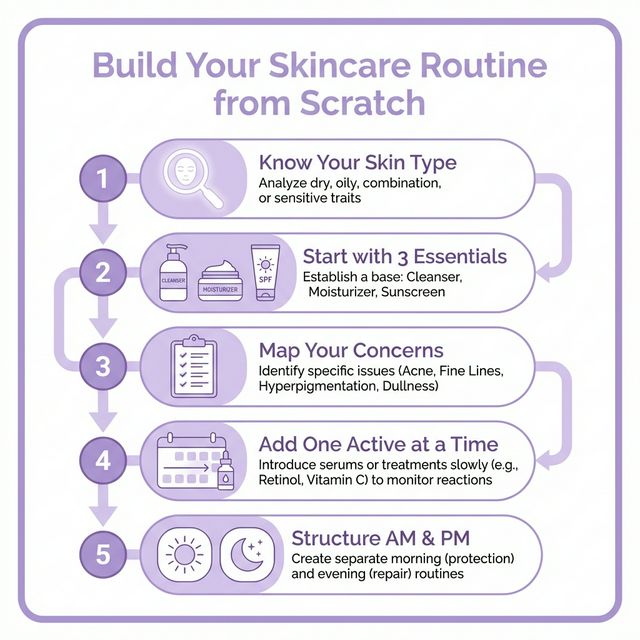
Step 1: Identify Your Skin Type
Everything starts here. Your skin type determines what base products you need, what textures work, and which ingredients to prioritize or avoid.
How to figure out your skin type:
- Wash your face with a gentle cleanser
- Pat dry and don’t apply anything
- Wait 60 minutes
- Check your skin:
| What You See After 60 Min | Your Skin Type | What This Means |
|---|---|---|
| Shiny all over, especially T-zone | Oily | Larger pores, prone to breakouts, needs lightweight products |
| Tight, flaky, or rough patches | Dry | Smaller pores, needs richer moisturizers, may be sensitive |
| Oily T-zone, dry/normal cheeks | Combination | Most common type — different zones need different approaches |
| Comfortable, no shine or tightness | Normal | Least reactive, most product types work well |
| Stinging, redness, or reacts to many products | Sensitive | Needs fragrance-free, minimal-ingredient products |
Skin type ≠ skin condition. Your type (oily, dry, combination) is mostly genetic. Your conditions (acne, pigmentation, dehydration) are what you treat. You can be oily-skinned AND dehydrated. Getting this distinction right prevents buying the wrong products.
Step 2: Lock in Your 3 Essentials
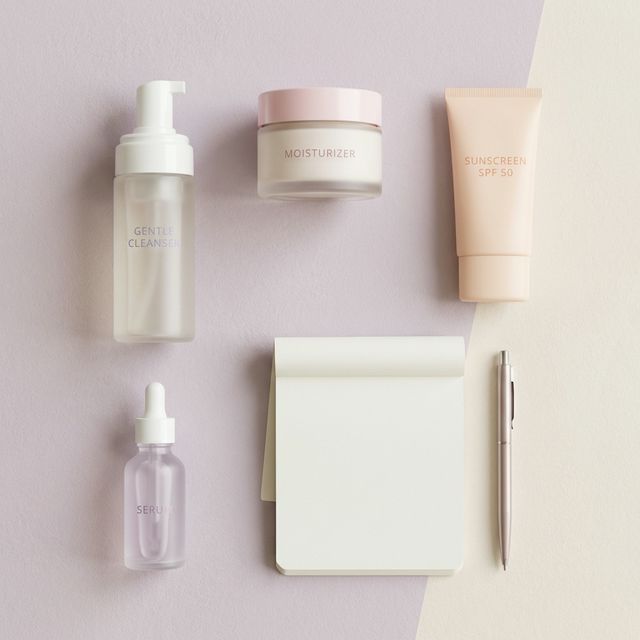
Before adding anything fancy, get these three right. They’re the foundation everything else builds on.
Cleanser — removes what shouldn’t be on your skin:
- Oily/combination: Gel or foaming cleanser (gentle, sulfate-free)
- Dry/sensitive: Cream or milk cleanser (non-foaming, no stripping)
- All types: pH 5.0–6.0, fragrance-free if sensitive
Moisturizer — locks in hydration and protects the barrier:
- Oily: Lightweight gel-cream, oil-free
- Dry: Rich cream with ceramides, glycerin, or hyaluronic acid
- Combination: Gel-cream or lightweight lotion
- Sensitive: Minimal ingredients, ceramide-based, fragrance-free
Sunscreen (AM only) — protects everything else from being undone by UV:
- SPF 30 minimum, SPF 50 preferred
- Broad spectrum (UVA + UVB)
- If sensitive: mineral (zinc oxide) formula
- The best sunscreen is the one you’ll actually wear every day
Don’t skip this step. Every active ingredient you add later — retinol, vitamin C, acids — makes your skin more sun-sensitive. Without SPF, you’re accelerating the damage you’re trying to fix.
Step 3: Map Your Concerns to Ingredients
Once your 3 essentials are locked in for 4–6 weeks and your skin is stable, it’s time to address specific concerns. But don’t just grab whatever’s trending — match your concern to the right active ingredient.
| Your Concern | Best Starting Active | How It Works |
|---|---|---|
| Acne / breakouts | Salicylic acid (BHA) 2% | Unclogs pores from inside, anti-inflammatory |
| Dark spots / pigmentation | Vitamin C (L-ascorbic acid 10–20%) | Brightens, inhibits melanin production |
| Fine lines / aging | Retinol 0.3–0.5% | Boosts collagen, speeds cell turnover |
| Dull / uneven texture | AHA (glycolic or lactic acid) | Dissolves dead surface cells, reveals fresher skin |
| Redness / rosacea | Azelaic acid 10–15% | Anti-inflammatory, reduces redness and bumps |
| Dehydration (not dryness) | Hyaluronic acid serum | Pulls water into skin, plumps |
Key rule: Pick one concern to start with. Not three. One active, one target, one result to measure. You can layer in more later.
Step 4: Build Your Introduction Calendar
This is where most people go wrong — they add everything at once, their skin freaks out, and they blame the products instead of the process.
The safe introduction schedule:
| Week | What to Do |
|---|---|
| Weeks 1–4 | Use only your 3 essentials (cleanser, moisturizer, SPF). Let skin stabilize. |
| Week 5 | Add your first active — use it 2–3 times per week, not daily |
| Weeks 6–8 | If no irritation, increase frequency. If irritation, reduce or pause. |
| Week 9+ | Once the first active is tolerated daily (or at target frequency), consider adding a second |
Between each new product: Wait at minimum 2 weeks with stable skin before introducing the next product. This way, if something causes a reaction, you know exactly what it was.
Keep a simple log. Note the date you started each product and how your skin responds. “Started retinol Tues, slight dryness by Fri, fine by next Wed” — this kind of tracking prevents confusion and panic-switching.
Step 5: Structure Your AM & PM
Morning and evening routines serve different purposes. Morning is about protection. Evening is about repair. Structure accordingly.
The layering principle: Apply products from thinnest to thickest consistency. Water-based serums go before cream moisturizers. Sunscreen always goes last in AM.
| Order | AM (Protect) | PM (Repair) |
|---|---|---|
| 1 | Gentle cleanser | Cleanser (double cleanse if wearing SPF/makeup) |
| 2 | Antioxidant serum — vitamin C (if using) | Treatment — retinoid or exfoliant (if using) |
| 3 | Moisturizer | Targeted serum (if using) |
| 4 | Sunscreen SPF 30–50 | Moisturizer (can be richer at night) |
Conflict rules to know:
- Don’t use AHA/BHA and retinoids on the same night (alternate nights instead)
- Vitamin C works best in AM (antioxidant protection + UV defense)
- Retinoids always go in PM (they degrade in sunlight)
The Right Routine
AM Routine (Built from Scratch)
- Gentle cleanser — 60 seconds, lukewarm water
- Antioxidant serum (optional) — vitamin C if targeting pigmentation
- Moisturizer — choose texture based on your skin type
- Sunscreen — two finger-lengths, SPF 30–50, always last
PM Routine (Built from Scratch)
- Cleanser — double cleanse if you wore SPF or makeup
- Active treatment (optional) — retinoid, BHA, or AHA on alternate nights
- Hydrating serum (optional) — hyaluronic acid or niacinamide
- Moisturizer — can use a richer formula at night
Remember: The “optional” steps stay optional until you’ve earned them. Start with 3 essentials, add one active at a time, and build up from there.
Common Mistakes
1. Building Your Routine from Someone Else’s
The most common trap. You watch a creator’s routine, buy the same products, and expect the same results. But their skin type, concerns, climate, and sensitivity are different from yours. What works for oily, acne-prone skin in a humid climate won’t work for dry, sensitive skin in a cold one.
Fix: Use the framework above to build YOUR routine based on YOUR skin type and concerns. Other routines are inspiration, not prescriptions.
2. Buying Actives Before Your Foundation Is Solid
Serums and treatments are exciting. Cleanser and moisturizer aren’t. But actives work best on balanced, hydrated skin with an intact barrier. Skipping the foundation and jumping straight to retinol or acids is why many people experience irritation and conclude that “skincare doesn’t work for me.”
Fix: Lock in your 3 essentials for 4–6 weeks before adding any actives. See Proper Skincare Routine for Beginners for the essential foundation.
3. Changing Products Too Often
Skin cell turnover takes 28–40 days. Most products need 4–12 weeks to show visible results. If you switch products every week or two, nothing gets a fair trial and you’re stuck in a cycle of buying and discarding.
Fix: Commit to each product for at least 6 weeks before judging it. The only reason to stop sooner is a clear negative reaction (burning, breakouts in unusual areas, rash).
4. Ignoring Climate and Season
Your routine should adapt. A heavy cream moisturizer that’s perfect in winter may cause breakouts in summer. A lightweight gel that works in August may not be enough in January.
Fix: Have seasonal adjustments planned — lighter moisturizer and gel SPF in warm months, richer moisturizer and cream SPF in cold months. Your cleanser usually stays the same year-round.
5. Overcomplicating Too Early
Ten products, three serums, toner, essence, ampoule, eye cream, face oil. Each one added because it “might help.” The result: a 20-minute routine you don’t maintain, product interactions you can’t predict, and no way to know what’s helping vs. hurting.
Fix: Start with 3. Add to 4. Then maybe 5. Most effective routines have 4–5 products. More than that should have a clear reason for each addition.
FAQ
How long does it take to build a complete routine?
Plan for 3–4 months from zero to a fully personalized routine. Weeks 1–4: establish your 3 essentials. Weeks 5–8: add your first active. Weeks 9–12: fine-tune and potentially add a second active. Rushing this timeline is the #1 cause of irritation and wasted money.
Do I need different products for morning and night?
Your cleanser and moisturizer can be the same for both. The main differences: AM needs sunscreen (never skip it), PM is where treatments like retinoids go (they degrade in sunlight). Some people prefer a lighter moisturizer in AM under sunscreen and a richer one at night, but it’s not required.
How much should I spend on skincare products?
Price doesn’t equal effectiveness. Many drugstore products contain the same active ingredients at the same concentrations as premium brands. Focus on: correct ingredients for your concern, appropriate concentration, and a formula your skin tolerates. A complete 3-step routine can cost under ₹1,000 or under $30 with well-chosen drugstore products.
What if I don’t know what’s causing my skin issues?
Start with the basics — your 3 essentials — and observe. Many skin issues (dehydration, mild breakouts, dullness) resolve when you simply cleanse properly, moisturize consistently, and protect from UV. If problems persist after 6 weeks of consistent basics, that’s when you target specific concerns with actives. For persistent or severe issues, consult a dermatologist.
Can I build a routine if I have multiple skin concerns?
Yes, but address them one at a time. Pick your most bothersome concern first, find the right active for it, and stabilize. Then add the next. Trying to treat acne, pigmentation, and aging all at once with three new actives is a recipe for irritation. Most concerns also share overlapping solutions — retinoids address both acne and aging, for example.
The Bottom Line
Building a skincare routine from scratch isn’t about finding the perfect products — it’s about following a framework:
- Know your skin type — this determines your base products
- Start with 3 essentials — cleanser, moisturizer, sunscreen
- Map your concerns — match each concern to a specific active ingredient
- Add one thing at a time — 2–4 weeks between introductions
- Structure AM (protect) and PM (repair) — layering order matters
The routine you build yourself, based on your skin’s actual needs, will always outperform a routine you copied from someone else.
Not sure where your skin stands? Start a skin scan to get a personalized assessment of your skin type, concerns, and a routine recommendation built around what your skin actually needs.
Related Guides
- Routine Order & Layering Hub — complete guide to product sequencing and layering
- Proper Skincare Routine for Beginners — the essential 3-step foundation
- How to Introduce Actives Without Irritation — the safe way to add treatments
This content is for informational purposes only and does not replace professional medical advice. Consult a board-certified dermatologist for personalized treatment recommendations.