Your skin stings, burns, and reacts to everything. Products that used to feel gentle now irritate. You might look shiny but feel tight. Something is wrong—and that something is your skin barrier.
The good news: your barrier can heal. The bad news: it requires patience, not more products.
At a Glance
- Timeline: 2–4 weeks for full repair
- Difficulty: Easy (it’s about doing less)
- Who needs this: Anyone with persistent sensitivity, stinging, or reactive skin
- Key action: Stop all actives, rebuild with barrier-supporting ingredients
- Goal: Restore protection → reintroduce actives safely
Start here → Skin Barrier & Sensitivity Hub — your complete guide to barrier health, sensitivity, and gentle skincare.
What Is the Skin Barrier?
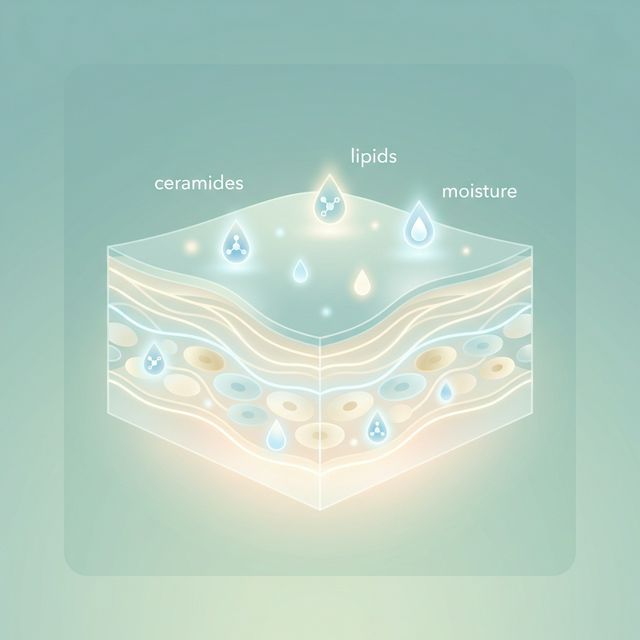
Your skin barrier (also called the moisture barrier or stratum corneum) is the outermost layer of your skin. Think of it as a brick wall:
- Bricks = skin cells (corneocytes)
- Mortar = lipids (ceramides, cholesterol, fatty acids)
This barrier has two critical jobs:
- Keep water in — prevent transepidermal water loss (TEWL)
- Keep irritants out — protect from environmental damage, allergens, bacteria
When the barrier is intact, your skin feels comfortable, hydrated, and resilient. When it’s damaged, everything changes.
Signs Your Barrier Needs Repair
Classic Symptoms
- Stinging/burning with products — even gentle ones irritate
- Tight, shiny skin — looks glossy but feels stretched
- Unusual dryness AND oiliness — both at the same time
- Increased sensitivity — things that never bothered you now do
- Visible redness or flaking — especially after cleansing
- Texture getting worse — despite using “good” products
The Timeline Question
Barrier damage usually starts 1–2 weeks before you notice symptoms. Think back: Did you recently add a new active? Layer multiple acids? Start a retinoid without ramping up?
What Causes Barrier Damage
Common Culprits
- Over-exfoliation — daily acids, scrubs, or too many actives at once
- Aggressive retinoid use — starting too strong or too fast
- Harsh cleansers — high-pH or sulfate-heavy formulas strip oils
- Alcohol-based toners — “clarifying” products often do more harm than good
- Weather stress — cold wind, indoor heating, air conditioning
- Hot water — damages the lipid layer
The most common mistake: Trying to “push through” irritation. If your skin is stinging, using more products will not help. Your barrier cannot heal while under constant assault.
What’s Actually Happening
When your barrier is damaged:
- Lipid layers thin out — the “mortar” between your skin cells breaks down
- Water escapes — increased TEWL leads to dehydration
- Irritants penetrate — things that couldn’t reach deeper layers now can
- Inflammation cycles — your skin overreacts to everything, causing more damage
It’s a vicious cycle. Breaking it requires stopping the damage first.
The Barrier Repair Protocol
This is intentionally boring. Your skin needs zero stimulation while it heals.
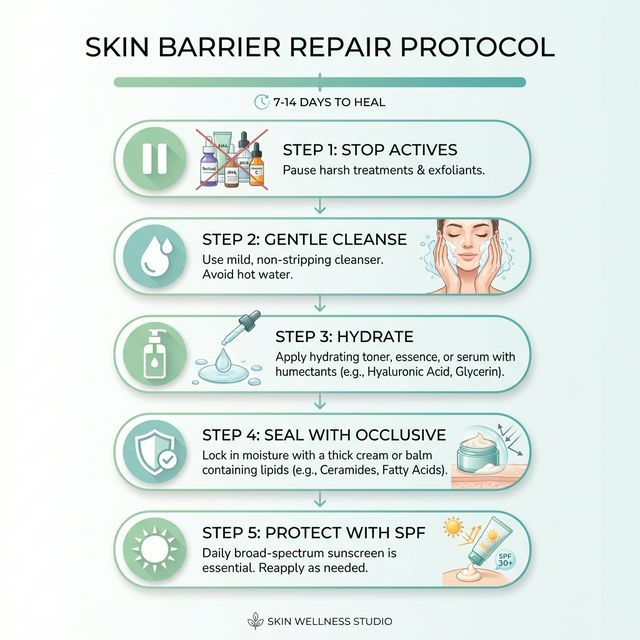
Phase 1: Stop the Assault (Days 1–7)
Eliminate all actives:
- Retinoids (tretinoin, adapalene, retinol)
- Acids (AHA, BHA, PHA)
- Vitamin C serums
- Benzoyl peroxide
- Scrubs and physical exfoliants
- Alcohol-based toners
Simplify to 3 steps:
- Gentle cleanser (cream or milk texture)
- Barrier-repair moisturizer
- Mineral sunscreen SPF 30+
Phase 2: Rebuild the Barrier (Days 7–21)
Your skin is less reactive but still fragile. Focus on barrier-building ingredients:
Core repair ingredients:
- Ceramides — restore the lipid barrier directly
- Cholesterol — works with ceramides for full repair
- Fatty acids — linoleic, oleic acid support barrier function
- Niacinamide (2–5%) — anti-inflammatory, boosts ceramide production
- Panthenol (B5) — soothes and promotes healing
- Squalane — lightweight, non-irritating moisture
Optional additions:
- Centella asiatica — calming, promotes healing
- Aloe vera — soothing hydration
- Colloidal oatmeal — anti-itch, barrier-supportive
Pro tip: Look for products with the “3:1:1” ratio of ceramides, cholesterol, and fatty acids—this mimics your skin’s natural lipid composition and provides optimal repair support.
Phase 3: Test and Maintain (Day 21+)
Before reintroducing actives, your skin should:
- Feel comfortable without products
- Not sting with moisturizer
- Look calm (no unusual redness)
- Feel hydrated, not tight
If you’re not there yet, continue Phase 2 for another 1–2 weeks.
Repair Routine
Morning
- Water rinse or gentle cleanser — no foaming, no scrubbing
- Lightweight moisture layer — if needed (hyaluronic acid serum or light lotion)
- Barrier-repair moisturizer — ceramide-based preferred
- Mineral sunscreen SPF 30+ — zinc oxide is gentlest
Evening
- Gentle cleanser — cream or milk texture, no actives
- Hydrating toner — optional, skip if you’re sensitive
- Barrier-repair moisturizer — same as AM, or heavier cream
- Occlusive on dry areas — Vaseline, Aquaphor, or CeraVe Healing Ointment on worst spots
Common Mistakes During Repair
1. Switching Products Too Often
Your skin needs consistency. Testing new products every few days prevents healing and makes it impossible to identify what’s helping or hurting.
Fix: Stick with 3–4 products for at least 2 weeks before evaluating.
2. Using “Natural” Products Instead
Botanical extracts, essential oils, and fragrance can all irritate damaged barriers. “Natural” doesn’t mean gentle.
Fix: During repair, prioritize minimal-ingredient formulas. No fragrance, no essential oils.
3. Skipping Sunscreen
UV damage compounds barrier damage. You’re also more photosensitive with a compromised barrier.
Fix: Mineral sunscreen daily, even indoors near windows.
4. Reintroducing Actives Too Fast
The moment your skin feels better, it’s tempting to restart your old routine. This almost always causes a setback.
Fix: Wait until symptoms have been gone for at least a week. Then reintroduce ONE active at low frequency (1–2x/week).
5. Using Hot Water
Hot water strips the lipid barrier. Even if it feels soothing in the moment, it prolongs healing.
Fix: Lukewarm water only for cleansing. Brief showers.
When to Reintroduce Actives
The Checklist
Before adding any actives back, confirm:
- Products don’t sting or burn
- Skin looks calm (no unusual redness)
- Skin feels hydrated without products
- Symptoms have been gone for 1+ week
The Protocol
- Week 1: ONE active, 1x/week only
- Week 2: If tolerated, increase to 2x/week
- Week 3: If still tolerating, consider alternate-night use
- Week 4+: Slowly add a second active on non-consecutive nights
Never return to your old aggressive routine. That’s how you ended up here.
For detailed reintroduction: Over-Exfoliated? The 7-Day Barrier Reset
When to See a Dermatologist
Some symptoms require professional evaluation:
- No improvement after 4 weeks of simplified routine
- Spreading rash or hives — could indicate allergy
- Persistent redness with visible blood vessels — may be rosacea
- Oozing, crusting, or infection signs
- Symptoms that started with a new prescription
A dermatologist can distinguish barrier damage from conditions that mimic it (rosacea, eczema, contact dermatitis) and provide prescription support if needed.
FAQ
How long does it really take to heal?
For most people, 2–4 weeks with a simplified routine. Severe damage may take 6–8 weeks. The key is stopping irritation completely—partial changes lead to partial results.
Can I use face oils during repair?
Yes, if they’re simple and non-irritating. Good options: squalane, jojoba, rosehip seed oil. Avoid: fragrant essential oils, high-concentration vitamin E.
What if I have acne and barrier damage?
Barrier repair takes priority. Actives won’t work well on damaged skin anyway—they’ll just irritate. Heal first, then address acne with a gentler approach.
Is “barrier repair cream” necessary?
Not specifically—you need ceramides, lipids, and non-irritating ingredients. Many affordable moisturizers qualify. The label “barrier repair” is marketing, not a regulated term.
Why did this happen even though I followed product instructions?
Product instructions assume you’re using only that product. Layer multiple actives, and the cumulative irritation exceeds what any single product tested for.
The Bottom Line
Barrier repair requires patience, not products.
- Stop all actives — yes, all of them
- Simplify to 3 steps — cleanse, moisturize, protect
- Use barrier-supporting ingredients — ceramides, niacinamide, panthenol
- Wait 2–4 weeks — consistency matters more than product switching
- Reintroduce slowly — one active at a time, low frequency
Your barrier will heal. When it does, you’ll have the foundation to use actives effectively—without the damage.
Need help tracking your skin’s recovery? Use a skin scan to monitor changes week by week.
This content is for informational purposes only and does not replace professional medical advice. Consult a board-certified dermatologist for personalized treatment recommendations.