You’ve seen 10-step routines, refrigerators full of serums, and influencers layering seven products before breakfast. It looks overwhelming — so you either do nothing or copy someone else’s routine and wonder why it doesn’t work for you.
Here’s the truth: a proper beginner routine has 3 steps. Everything else is optional until those three are locked in and working. This guide shows you exactly what to do, in what order, and when you’re ready to add more.
At a Glance
- 3 steps are all you need to start — cleanser, moisturizer, SPF
- Order matters — thin to thick, water-based before oil-based
- Morning and night are different — AM protects, PM repairs
- Add one product at a time — wait 2–4 weeks before adding another
- Consistency beats complexity — a simple routine done daily outperforms a 10-step routine done occasionally
Start here → Routine Order & Layering Hub — your complete guide to building, ordering, and troubleshooting skincare routines.
60-Second Self Check
Which of these sound familiar?
Your current routine:
- You don’t have a consistent routine yet
- You use whatever products you have, in no particular order
- You skip sunscreen most days
- You’ve tried products that didn’t seem to do anything
Your skin right now:
- Feels oily in some areas, dry in others
- Occasional breakouts you can’t explain
- Looks dull or uneven
- Gets irritated when you try new products
→ 2+ checks in either group? This guide is for you. Start with the 3-step foundation below.
The Beginner Routine: 3 Steps That Matter
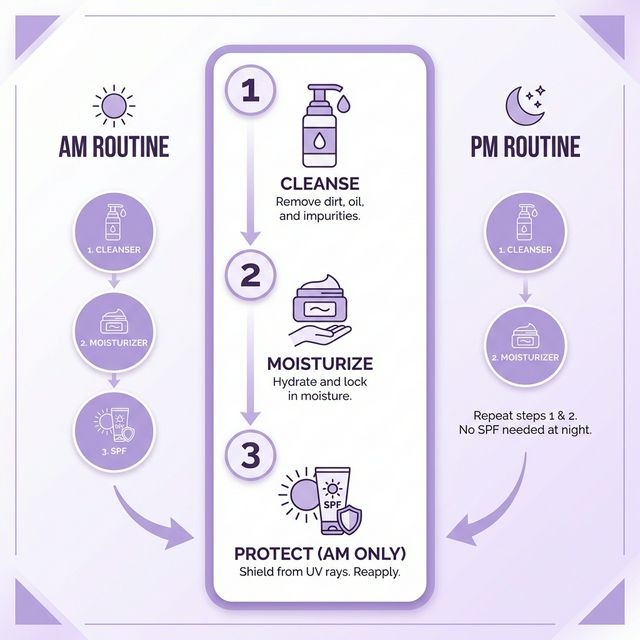
Step 1: Cleanser
What it does: Removes dirt, oil, sweat, sunscreen, and pollution from your skin. Without cleansing, everything you apply afterward sits on top of grime instead of absorbing into clean skin.
What to look for:
- Gentle, non-foaming or low-foam formula
- pH 5.0–6.0 (close to your skin’s natural pH)
- No sulfates (SLS/SLES) — they strip too aggressively
- Fragrance-free if your skin is sensitive
How to use it:
- Wet your face with lukewarm water
- Apply a small amount and massage gently for 60 seconds
- Rinse thoroughly — no residue should remain
- Pat dry with a clean towel (don’t rub)
Lukewarm, not hot. Hot water strips your natural oils and weakens the skin barrier. If it’s comfortable on the inside of your wrist, it’s the right temperature.
Step 2: Moisturizer
What it does: Locks in hydration, repairs the skin barrier, and prevents water loss. Every skin type needs moisturizer — including oily skin. Skipping it tells your skin to overproduce oil to compensate.
What to look for:
- Dry skin: Cream-based with ceramides, glycerin, or hyaluronic acid
- Oily skin: Lightweight gel or gel-cream, oil-free
- Sensitive skin: Fragrance-free, minimal ingredients, ceramide-based
- Normal/combination: Any well-formulated moisturizer
How to use it:
- Apply to slightly damp skin (right after cleansing/patting)
- Use about a nickel-sized amount for your full face
- Spread gently — don’t pull or tug the skin
- Let it absorb for 1–2 minutes before the next step
Step 3: Sunscreen (AM Only)
What it does: Protects against UV damage — the single biggest cause of premature aging, dark spots, and uneven texture. Everything else in your routine is undone if UV damage accumulates unchecked.
What to look for:
- SPF 30 minimum (SPF 50 preferred)
- Broad spectrum (UVA + UVB coverage)
- A formula you’ll actually wear every day — cosmetic elegance matters
- Mineral (zinc oxide) if your skin is sensitive or reactive
How to use it:
- Apply as the last step in your AM routine
- Use two finger-lengths for your face (more than you think)
- Pat gently — don’t rub it in aggressively
- Wait 2–3 minutes before makeup if applicable
- Reapply every 2 hours if outdoors
Sunscreen is non-negotiable. Even on cloudy days, even if you’re indoors near windows. UVA rays penetrate glass and clouds. This is the single most evidence-backed step in any skincare routine.
When to Add More Steps
Once your 3-step routine is consistent for 4–6 weeks and your skin is stable (not irritated, not breaking out from the basics), you can add one product at a time.
| Sign You’re Ready | What to Add | Why |
|---|---|---|
| Skin is stable on 3 steps | One active serum or treatment | Your baseline is solid enough to handle more |
| No irritation from basics | An exfoliant (AHA/BHA, 1–2x/week) | Removes dead cells, improves texture |
| Wanting to target a concern | A targeted serum (vitamin C, niacinamide, retinol) | Address specific issues without overloading |
The one-at-a-time rule: Add one new product, use it for 2–4 weeks, see how your skin responds. If no irritation, you can add another. If irritation appears, you know exactly what caused it.
| Order | AM Routine | PM Routine |
|---|---|---|
| 1 | Cleanser | Cleanser (double cleanse if wearing SPF/makeup) |
| 2 | Serum (optional) | Treatment — retinoid, exfoliant (optional) |
| 3 | Moisturizer | Serum (optional) |
| 4 | Sunscreen | Moisturizer |
Rule of thumb: Apply products from thinnest to thickest consistency. Water-based serums go before cream moisturizers. Sunscreen always last in AM.
The Right Routine
AM Routine (Beginner)
- Gentle cleanser — 60 seconds, lukewarm water
- Moisturizer on damp skin — nickel-sized amount
- Sunscreen — two finger-lengths, pat gently
PM Routine (Beginner)
- Cleanser — 60 seconds (double cleanse if you wore SPF/makeup)
- Moisturizer — slightly richer formula is fine at night
- That’s it — no actives needed yet
Key principle: Morning protects. Night repairs. Keep both simple until you have a reason to add complexity.
Common Mistakes
1. Starting With Too Many Products
The #1 beginner mistake. You buy a cleanser, toner, serum, eye cream, moisturizer, and SPF all at once. If your skin reacts badly, you have no idea which product caused the problem.
Fix: Start with 3 products. Add one at a time with 2–4 weeks between additions.
2. Skipping Moisturizer Because Skin Is Oily
Oily skin still needs hydration. Skipping moisturizer damages the moisture barrier, which signals your skin to produce even more oil. It’s counterintuitive but consistently proven.
Fix: Use a lightweight, gel-based moisturizer. Your skin will calibrate oil production within 2–4 weeks. See What Happens When You Skip Moisturizer.
3. Skipping Sunscreen
UV damage causes more visible skin aging than any other factor. It worsens dark spots, creates uneven texture, and breaks down collagen. Every other product in your routine works less effectively without SPF backing it up.
Fix: Find a sunscreen you like the feel of — that’s the one you’ll actually use. If you hate the texture, try a different formula rather than skipping it entirely.
4. Washing With Hot Water
Hot water feels good but strips natural oils, weakens the barrier, and increases sensitivity. Your face then overcompensates with more oil or becomes dry and flaky.
Fix: Use lukewarm water. Always. See Why Skin Feels Tight After Washing for more on this.
5. Expecting Instant Results
Skincare works on your skin’s cell turnover cycle, which takes 28–40 days. Most products need 4–12 weeks to show visible results. Switching products every week means nothing gets a fair shot.
Fix: Commit to your basic routine for at least 6 weeks before judging results. Take photos in the same lighting once a week to track changes you might not notice day-to-day.
FAQ
How many skincare products do I actually need?
Three: cleanser, moisturizer, and sunscreen. That’s a complete beginner routine. Everything else — serums, toners, eye creams, masks — is optional and should only be added once your foundation is solid and your skin is stable. A 3-step routine done consistently beats a 10-step routine done inconsistently.
Do I really need sunscreen every day, even if I stay indoors?
Yes, if you’re near windows. UVA rays penetrate glass and cause cumulative damage (aging, dark spots, collagen breakdown). If you genuinely don’t go near windows or leave the house, you can skip it on those specific days. But for most people, applying SPF in the morning is the simplest habit to maintain.
What order should I apply my skincare products?
Thinnest to thickest. In the morning: cleanser → serum (optional) → moisturizer → sunscreen. At night: cleanser → treatment (optional) → serum (optional) → moisturizer. Sunscreen is always the last step in AM. Each layer should mostly absorb before applying the next one.
Should I use the same moisturizer morning and night?
You can. There’s nothing wrong with using the same moisturizer for both AM and PM. Some people prefer a lighter formula in the morning (especially under sunscreen) and a richer one at night. But if one product works well for both, that’s perfectly fine and simplifies things.
How do I know if a product is breaking me out?
Introduce one product at a time and wait 2–4 weeks. If new breakouts appear in areas where you don’t normally break out, and they started after introducing the product, it’s likely the cause. Stop using it and see if breakouts resolve within 1–2 weeks. See How to Introduce Actives Without Irritation for more detail.
The Bottom Line
A proper beginner skincare routine is simple:
- Cleanser — removes what shouldn’t be on your skin
- Moisturizer — keeps the good stuff in
- Sunscreen — protects against the #1 cause of skin damage
- Add more only when ready — one product at a time, 2–4 weeks apart
- Consistency is everything — 3 steps daily beats 10 steps occasionally
Get the basics right, keep them consistent, and your skin will be in the best possible position to improve.
Not sure what products are right for your skin? Start a skin scan for a personalized routine built around your specific concerns and skin type.
Related Guides
- Routine Order & Layering Hub — complete guide to building and ordering your routine
- What Happens When You Skip Moisturizer — why moisturizer matters for every skin type
- How to Introduce Actives Without Irritation — the safe way to add products to your routine
This content is for informational purposes only and does not replace professional medical advice. Consult a board-certified dermatologist for personalized treatment recommendations.