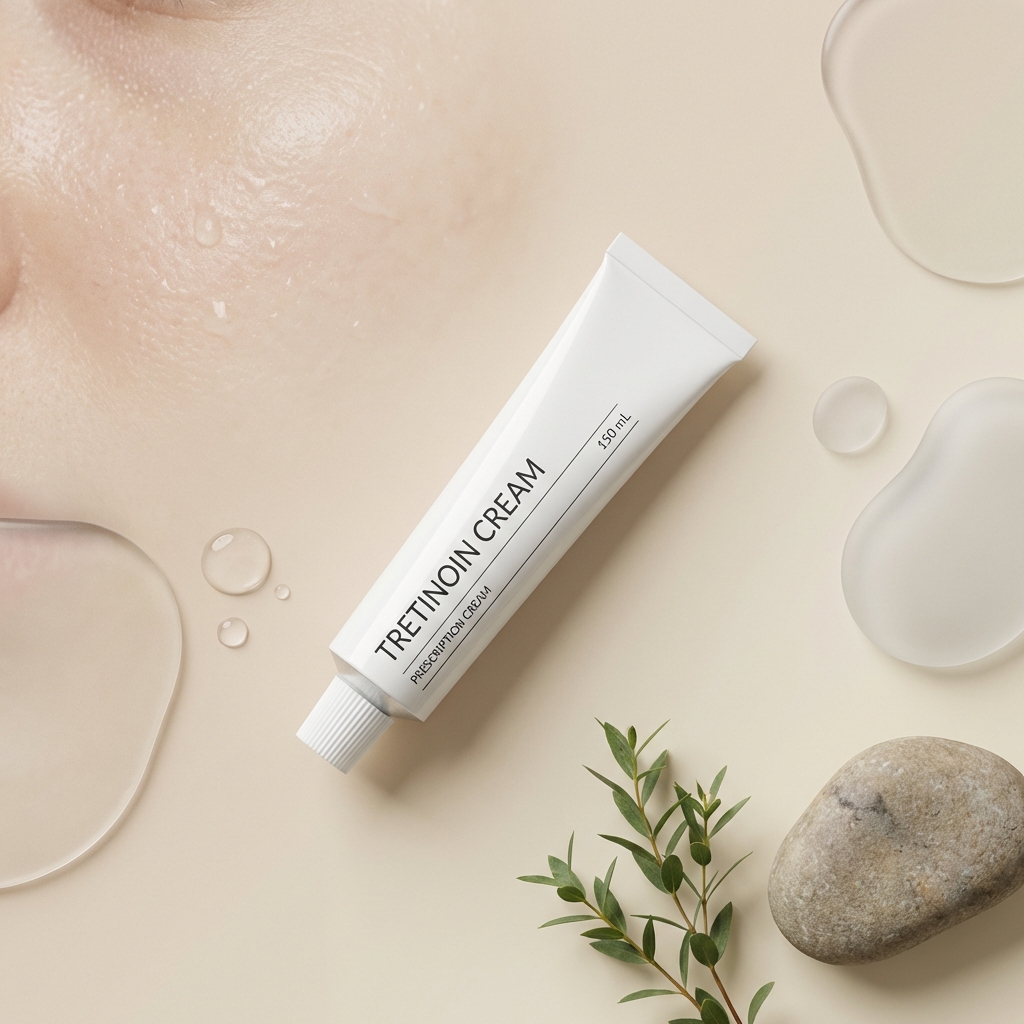
Tretinoin (Retin-A) is the gold standard prescription retinoid—the most studied ingredient for anti-aging, acne, and texture improvement. But its strength means more side effects, and most people fail because they start too aggressively.
This guide covers everything you need to start tretinoin correctly—and know when something’s actually wrong.
At a Glance
- Timeline: 12-16 weeks for visible results
- Amount: Pea-sized for entire face
- Start with: 2x per week + full buffer
- Expect: Purging, peeling, dryness first 6-8 weeks
- Key rule: Slow introduction = long-term success
This is part of our complete Retinoids Guide.
What Tretinoin Is (and What It Does)
Tretinoin is prescription-strength retinoic acid—the active form of vitamin A that your skin can use directly. Unlike retinol (which must convert in the skin), tretinoin works immediately and at full potency.
What it treats:
- Fine lines and wrinkles: The most-studied anti-aging ingredient. Proven to increase collagen production and reduce photodamage.
- Acne: Prevents comedones from forming, clears existing acne, reduces post-acne marks.
- Texture and tone: Accelerates cell turnover, fades hyperpigmentation, smooths rough skin.
- Sun damage: Partially reverses photoaging with consistent long-term use.
Available strengths:
- 0.025% — Starter strength, least irritating
- 0.05% — Standard strength, most commonly prescribed
- 0.1% — Maximum strength, highest efficacy but most irritating
Start at 0.025% or 0.05%. You can always increase later. Higher strength doesn’t mean faster results—it means more irritation with marginal additional benefit.
Purge vs. Irritation: How to Tell the Difference
This is the #1 concern when starting tretinoin. Here’s how to distinguish normal adjustment from a problem.
The Purge (Expected)
What it is: Tretinoin accelerates cell turnover, pushing existing clogs to the surface faster. Bumps that were forming deep in your skin appear as breakouts sooner than they would have naturally.
Characteristics:
- Happens in areas where you typically break out
- Breakouts are comedones, whiteheads, or pustules—not new types of acne
- Skin may be slightly red or dry, but not raw or painful
- Worse around weeks 2–8, then improves
- New breakouts slow down after 10+ weeks
What to do during purge: Keep going. This is temporary. The breakouts would have happened anyway—you’re just seeing them all at once. If it’s unbearable, reduce frequency but don’t quit.
Irritation/Retinoid Dermatitis (Problem)
What it is: Your skin barrier is damaged, either from overuse, not buffering, or true sensitivity to tretinoin.
Characteristics:
- Redness, burning, stinging with all products (even water)
- Excessive peeling and flaking (sheets of skin, not fine flakes)
- Occurs everywhere, not just where you break out
- Skin looks shiny-tight, raw, or waxy
- Getting worse after 4+ weeks instead of stabilizing
- Pain when applying moisturizer
If you experience irritation: Stop tretinoin immediately. Do a barrier reset for 7-14 days with only cleanser, moisturizer, and sunscreen. Restart at lower frequency (1x per week) with full buffer once your barrier has healed.
The Pea-Size Rule
One pea-sized amount for your entire face. That’s it.
Why Less Is More
- More product doesn’t mean faster results
- Excess just increases irritation without added benefit
- Tretinoin works by signaling skin cells, not by “coating” the skin
- Your skin can only process so much retinoic acid at once
Where NOT to Apply
- Eye area: Too thin and sensitive. Stop at the orbital bone.
- Corners of the mouth: High irritation risk, prone to cracking.
- Corners of the nose: Very thin skin, cracks and peels first.
- Neck: More sensitive than face. If treating neck, use even less and always buffer.
- Lips: Apply lip balm or vaseline before tretinoin as a barrier.
Pro tip: Apply a thin layer of Vaseline or Aquaphor to your eye area, lip corners, and around nostrils before tretinoin to protect these sensitive zones.
How to Buffer (The Sandwich Method)
Buffering means applying moisturizer before tretinoin to reduce irritation while still getting benefits. This is non-negotiable for beginners.
Full Buffer (Beginners — Weeks 1-8)
- Cleanse with gentle, non-stripping cleanser
- Wait until skin is completely dry (5-10 minutes)
- Apply moisturizer, wait 10–15 minutes
- Apply pea-sized tretinoin
- Optional: Light additional moisturizer on top (the “sandwich”)
Partial Buffer (After Tolerance Builds — Weeks 8-12)
- Cleanse
- Wait for skin to dry
- Apply tretinoin to dry skin
- Wait 10-15 minutes
- Apply moisturizer
No Buffer (Full Tolerance — Months 3+)
- Cleanse
- Wait 5-10 minutes for skin to dry
- Apply tretinoin to bare skin
- Wait, then moisturizer
Start with full buffer. There’s no prize for going buffer-free faster. Buffer for as long as you need to. Many people buffer forever and still get full results.
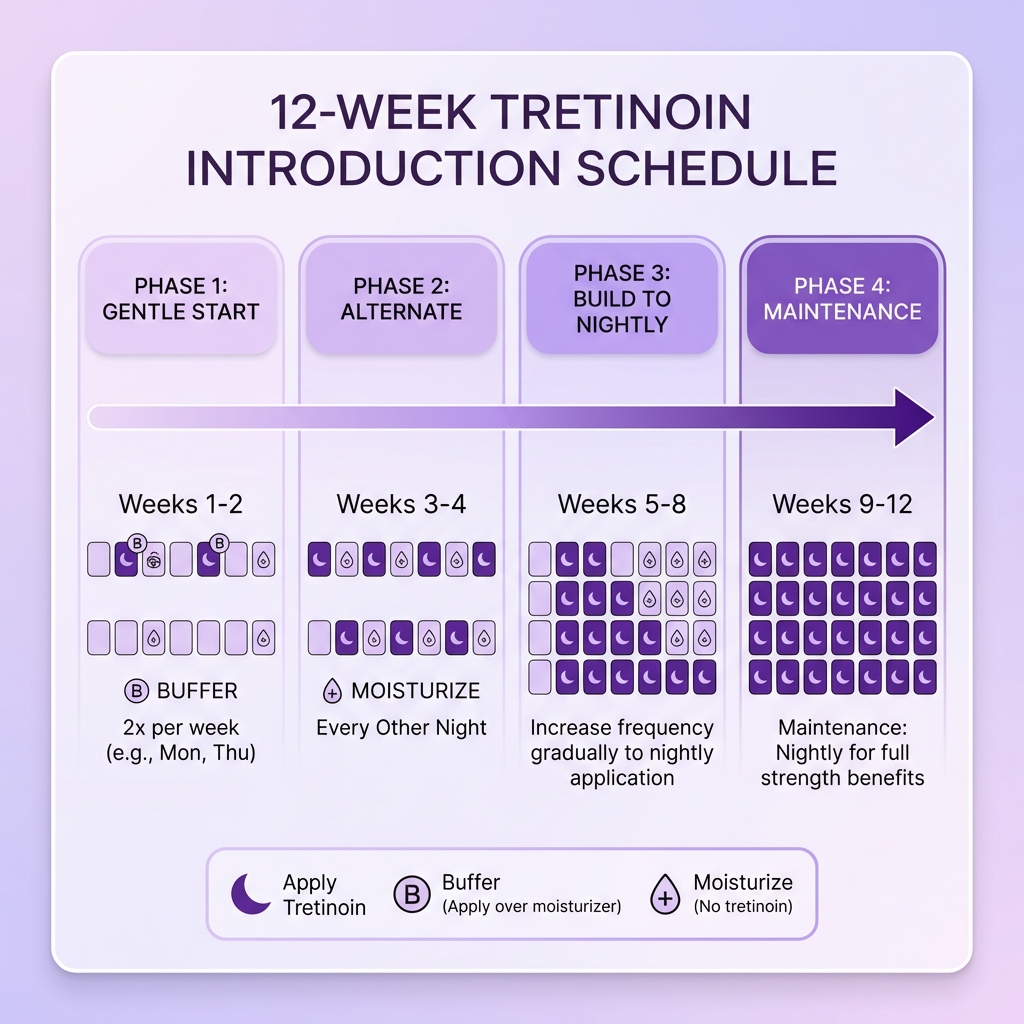
The Schedule: How to Ramp Up
Tretinoin is a marathon, not a sprint. Going slow prevents the irritation spiral that makes most people quit.
Phase 1: Gentle Start (Weeks 1–2)
Frequency: 2 nights per week only (e.g., Monday and Thursday)
- Always use full buffer
- Expect nothing visible yet
- Some mild dryness is normal
- If any stinging or redness, scale back to 1 night per week
Phase 2: Alternate (Weeks 3–4)
Frequency: Every other night (3-4 times per week)
- Continue full buffer
- Mild peeling and dryness is normal
- Purging may begin
- If irritation appears, drop back to 2x per week
Phase 3: Build to Nightly (Weeks 5–8)
Frequency: Gradually increase toward nightly
- Start with 2 nights on, 1 night off
- Then 3 nights on, 1 night off
- Then try nightly
- Reduce buffering if skin tolerates it
- Purging typically peaks during this phase
Phase 4: Maintenance (Weeks 9–12+)
Frequency: Nightly use as tolerated
- Can reduce buffering if desired
- Purging should slow or stop
- Visible texture improvement begins
- Full results continue building over 6-12 months
If you experience persistent irritation at any phase: Drop back to the previous phase for 2 weeks before trying again. There’s no shame in taking longer.
When to Pause Tretinoin
Stop temporarily if you experience:
- Severe stinging or burning with every product, including water
- Cracking, bleeding, or open sores on skin
- Large patches of peeling (not fine flakiness)
- Persistent redness that doesn’t improve on off-nights
- Skin feeling progressively worse after 8+ weeks without any improvement
- Tightness so severe your face can’t move normally
Pause for: 7–14 days minimum with a barrier-repair routine only (cleanser/moisturizer/sunscreen)
Restart at: 1x per week with full buffer, then rebuild over 8+ weeks even slower than before
Common Mistakes
1. Starting Too Strong
0.1% is not better than 0.025%. Start at the lowest strength your derm prescribes. You can always increase after 3-6 months.
2. Using Too Much
Pea-size only. More product = more irritation, not faster results.
3. Not Waiting for Skin to Dry
Applying to damp skin dramatically increases irritation. Pat dry after cleansing, wait 5-10 minutes.
4. Skipping Sunscreen
Tretinoin increases sun sensitivity significantly. Failing to wear SPF 30+ daily will worsen hyperpigmentation, increase irritation, and increase skin cancer risk.
5. Mixing with Other Actives Too Soon
No AHAs, BHAs, vitamin C, benzoyl peroxide, or other retinoids on tretinoin nights for the first 3 months. Your skin can’t handle it.
6. Giving Up During the Purge
12+ weeks minimum before judging. If you quit at week 6 during the purge, you’ve endured the worst without seeing the benefit.
7. Not Buffering
“Buffering reduces effectiveness” is a myth. Buffer generously, especially in the beginning.
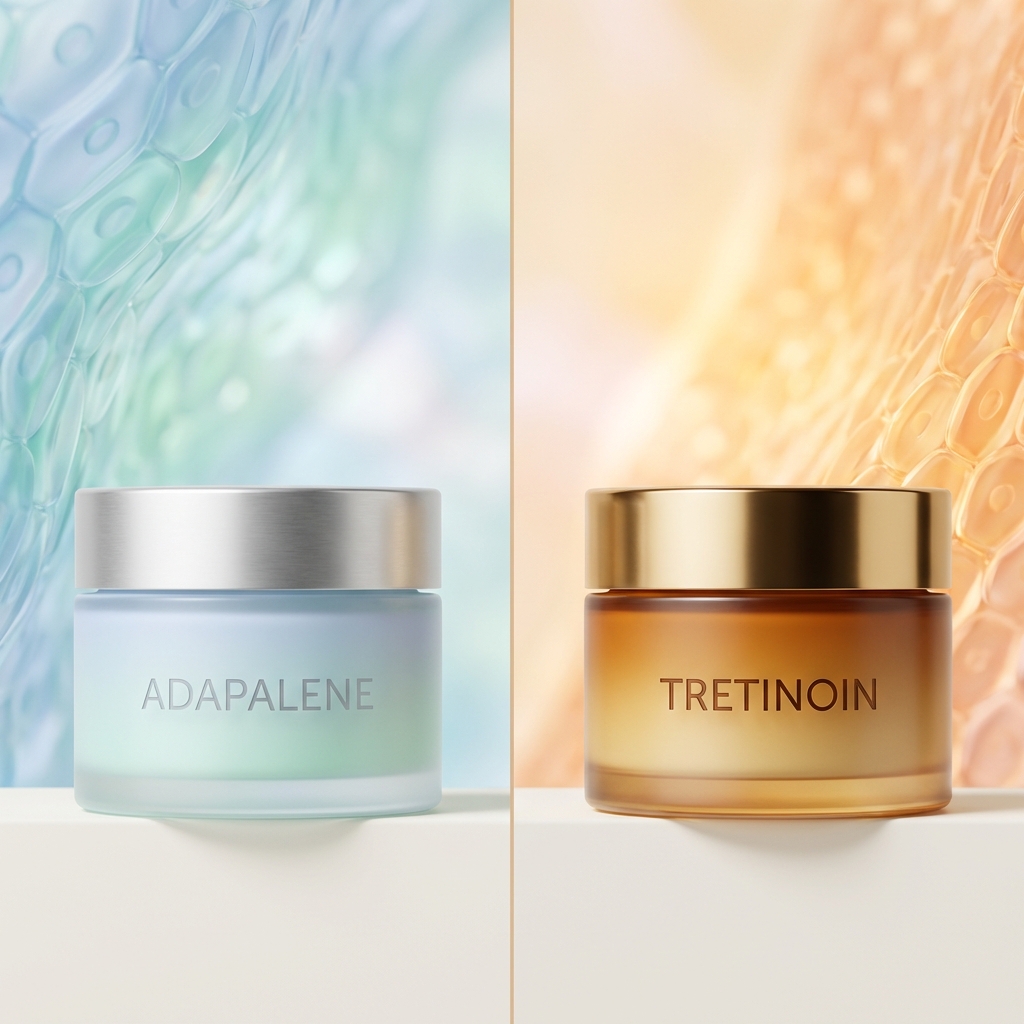
Tretinoin vs. Adapalene vs. Retinol
| Factor | Tretinoin | Adapalene | Retinol |
|---|---|---|---|
| Strength | Strongest | Moderate | Weakest |
| Prescription | Yes | OTC or Rx | OTC |
| Irritation | High | Moderate | Low |
| Anti-aging | Best studied | Limited data | Moderate |
| Acne | Excellent | Excellent | Mild |
| Best for | Anti-aging + acne | Acne beginners | Sensitive skin |
Not sure if tretinoin is right for you? If you’ve never used a retinoid, consider starting with adapalene first. It’s gentler, OTC, and lets you build tolerance before upgrading to tretinoin.
FAQ
How long until I see results from tretinoin?
Visible improvement: 12–16 weeks. Full anti-aging results: 6–12 months of consistent use. Tretinoin remodels deep skin structures—this takes time.
Is tretinoin or retinol better?
Tretinoin is more effective but more irritating. Retinol is gentler but weaker. For anti-aging, tretinoin is the gold standard if you can tolerate it.
Can I use tretinoin every night?
Eventually, yes—but not at the start. Build up gradually over 8-12 weeks. Many people use it nightly long-term.
Can I use tretinoin with vitamin C?
Yes, but not at the same time. Use vitamin C in the morning, tretinoin at night. Don’t layer them directly.
Can I use tretinoin while pregnant?
No. Tretinoin and all retinoids are contraindicated during pregnancy. Discontinue before trying to conceive and consult your doctor.
Should I use cream or gel tretinoin?
- Cream: More moisturizing, better for dry/normal skin
- Gel: Lighter, better for oily/acne-prone skin, may be more irritating
- Micro (microsphere): Slowest release, least irritating, good for sensitive skin
What if tretinoin doesn’t work after 6 months?
If you’re using it consistently with proper technique and still seeing no improvement, talk to your derm. You may need a higher strength, combination therapy, or a different diagnosis.
The Bottom Line
Tretinoin works—but it requires patience, proper buffering, and a slow ramp-up.
- Start low and slow: 0.025% or 0.05%, 2x per week
- Buffer generously: Moisturizer before tretinoin
- Expect the purge: Weeks 2-8, then improvement
- Know the difference between purge and damage
- Give it 12+ weeks before judging
Most people who “can’t tolerate tretinoin” actually just started too aggressively. Go slower than you think you need to.
Track your progress: Get the app and see your skin improve week by week.
This content is for informational purposes only and does not replace professional medical advice. Tretinoin is a prescription medication—consult a board-certified dermatologist before use.