You notice one raised edge. Your hand goes to it before you have decided anything. There is a brief sense of focus or relief, then soreness, shame, and a new mark to inspect tomorrow.
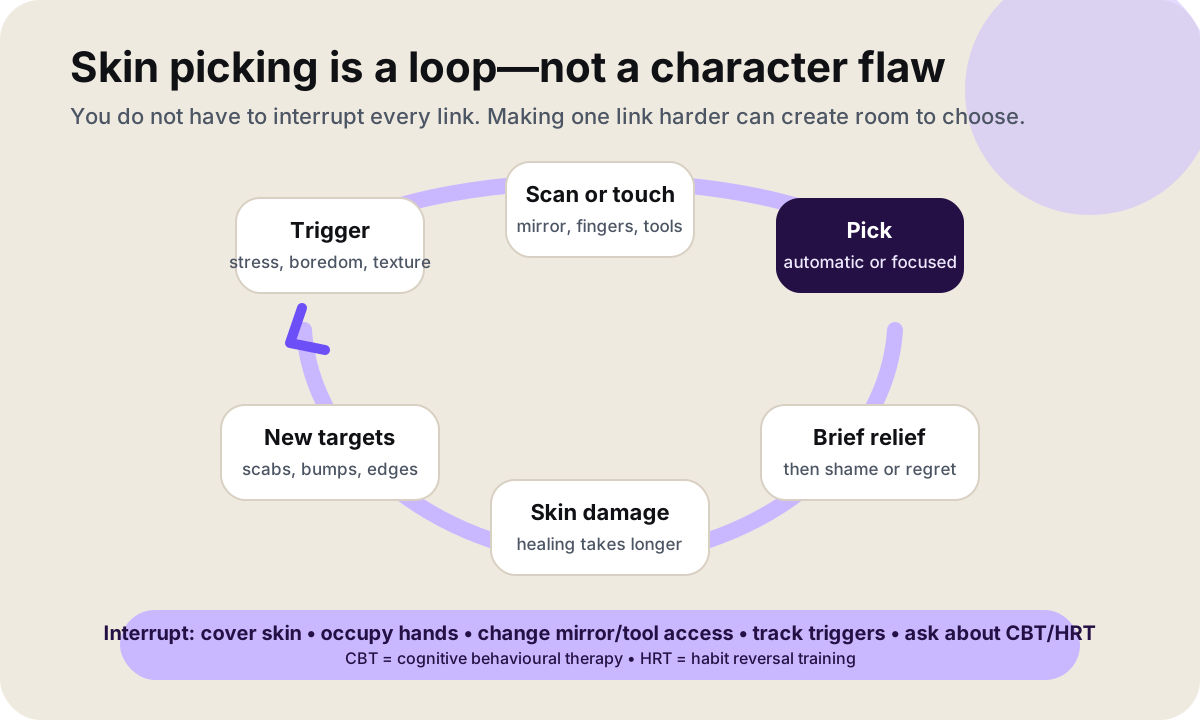
That is a loop, not a character flaw.
Skin picking can be automatic, focused, or both. Some people search for clogged pores; others pick rough, healing, or completely normal skin. If the urge feels hard to control, causes wounds, or affects daily life, the useful question is not “Why can’t I just stop?” It is “What keeps this loop easy to start, and what support would make it easier to interrupt?”
At a Glance
- Care for the skin: Clean fresh superficial wounds gently; keep acids, retinoids, and spot treatments off open skin
- Name the loop: Trigger → scan or touch → pick → brief relief → wound or texture → new trigger
- Change the setting: Move tools, alter mirror access, protect healing areas, and give your hands another job
- Reduce the target: Treat acne, eczema, or another trigger condition with a clinician instead of repeatedly extracting it
- Get support: Repeated unsuccessful attempts to stop, bleeding, distress, or daily-life impact are enough reason to ask for help
- Treat infection promptly: Spreading redness or discoloration, warmth, swelling, pus, worsening pain, or fever needs medical advice
This guide belongs to the Acne Scars & Texture hub.
First, check whether this has become more than an occasional habit
You deserve support if any of these feel familiar:
- you have tried to stop but keep returning to it;
- you pick until skin bleeds, breaks, or needs time to heal;
- you spend long periods scanning, squeezing, or trying to make skin feel “even”;
- you hide wounds or avoid people, photos, work, school, or intimacy;
- picking happens during stress, boredom, concentration, or without awareness;
- tools, magnifying mirrors, or repeated close-up photos are part of the ritual; or
- shame after picking makes you isolate, then picking becomes a way to cope again.
Clinicians may use the term excoriation disorder or skin-picking disorder when recurrent picking causes damage and distress or impairment and attempts to stop have not worked. You do not need to diagnose yourself or wait for the problem to become severe before asking for help.
If you picked today, start with care—not punishment
1. End the session
Put down tools and move away from the mirror or bright inspection light. Do not keep squeezing to “finish” the spot. Finishing is a moving target once skin is swollen and irritated.
2. Clean your hands and the area
For a small superficial wound, wash your hands, then gently clean the area with mild soap and water. Pat dry. Do not scrub, pour alcohol onto it, or repeatedly use hydrogen peroxide.
Plain petroleum jelly and a clean, suitable covering are often used to keep minor wounds moist while they heal. Facial location, depth, drainage, allergy, and infection risk can change wound-care advice, so ask a clinician or pharmacist if the wound is deep, repeatedly reopening, or difficult to cover.
3. Keep active skincare off broken skin
Pause retinoids, exfoliating acids, benzoyl peroxide, strong vitamin C, scrubs, peels, and scar procedures on the open area. More sting does not mean more repair.
4. Look for infection, not imperfection
Get medical advice for spreading redness or discoloration, increasing warmth or swelling, pus, worsening pain, red or dark streaks, fever, or feeling unwell. Rapid facial swelling, eye symptoms, breathing trouble, confusion, or severe illness needs urgent care.
Map the loop you actually have
Generic advice such as “keep your hands busy” works better when it is connected to a real trigger. For three to seven days, record only what helps you see the pattern—without photographing every pore.
| Notice | Useful detail |
|---|---|
| Time and place | In bed, at a desk, in the bathroom, during a video call |
| What happened just before | Stress, boredom, close-up mirror use, touching one rough edge |
| Body signal | Tension, restlessness, itch, pressure, urge to make skin smooth |
| Picking mode | Automatic and noticed late, or focused and planned |
| What gave brief relief | Removing a plug, seeing fluid, feeling an edge flatten, zoning out |
| What followed | Pain, bleeding, shame, hiding, more checking |
The record is not a scorecard. It shows which link is easiest to change first.
Build friction around the trigger
Make scanning less automatic
- Put away magnifying mirrors or turn them toward the wall.
- Use ordinary room light for routine care instead of a bright inspection light.
- Set a short timer before entering a high-risk bathroom or skincare routine.
- Move tweezers, extractors, pins, and lancets out of immediate reach.
- Keep nails short if nail edges are a common tool.
The aim is not to ban mirrors forever. It is to make the picking sequence less instant.
Protect a healing target
A clean dressing or hydrocolloid patch may create a physical pause for some superficial spots, but it is not suitable for every wound or infection. Do not seal pus, spreading inflammation, a deep wound, or an undiagnosed non-healing spot under a cosmetic patch. If a site repeatedly opens or does not heal, read Acne Spot Not Healing? and arrange an examination.
Give your hands a competing response
A competing response is an action that makes picking harder for a short period while the urge rises and falls. Examples include:
- clenching hands gently and holding them still;
- squeezing a soft ball or textured object;
- sitting on hands briefly when safe and comfortable;
- folding laundry, knitting, drawing, or another two-handed task; or
- wearing gloves during a known high-risk activity.
Choose something available where picking happens. A stress ball in another room will not interrupt a bathroom-mirror loop.
Use a delay you can repeat
“Never again” creates an all-or-nothing test. Try a two-minute delay, then five. Move rooms, use the competing response, and let the peak of the urge pass. If you still pick, care for the skin and restart at the next moment. One episode does not erase a useful interruption.
What treatment can look like
The NHS lists talking therapy, often cognitive behavioural therapy, as a common treatment for skin-picking disorder. A specific approach called habit reversal training builds awareness of triggers and teaches a less harmful action to use in place of picking.
Treatment may also address anxiety, obsessive-compulsive symptoms, attention difficulties, depression, trauma, or another condition when present. Medicine is sometimes considered by a qualified prescriber, but there is no universal product or dose to copy from someone else.
A useful care team can include:
- a primary-care clinician to assess wounds and coordinate referrals;
- a dermatologist to treat acne, eczema, itch, or another skin trigger; and
- a mental-health professional familiar with body-focused repetitive behaviours.
Treating the skin and the urge together is practical. Clearer acne can reduce targets, but it does not automatically retrain a loop that has become a coping strategy. Therapy can reduce the loop, but untreated itch or painful acne can keep supplying triggers.
What this means for acne scars
Picking and squeezing increase inflammation and tissue injury, which raises the chance of a lasting mark or scar. That is a reason to reduce harm, not a reason to panic after every episode.
Use this order:
- Close the wound and rule out infection.
- Reduce repeated picking and treat active acne.
- Let color and texture settle. Early redness or brown marks are not always permanent scars.
- Assess what remains. A dermatologist can separate post-inflammatory marks from raised or indented scars.
- Choose scar treatment only on healed, stable skin. Procedures performed while picking and acne remain active can create new injury before old injury has settled.
You do not need flawless control before seeing a dermatologist. Tell them about picking plainly so the plan protects your skin instead of assuming every lesion appeared on its own.
When to get medical help
Book care if picking causes cuts or bleeding, you cannot stop despite trying, the time or shame affects daily life, or wounds and scars are accumulating. Start with primary care, a mental-health professional, or a dermatologist—whichever you can access. Ask specifically for help with a body-focused repetitive behaviour or skin-picking disorder.
Get prompt medical advice for a deep wound, an area that will not heal, or signs of infection such as spreading redness or discoloration, heat, swelling, pus, worsening pain, fever, or feeling unwell.
If shame, anxiety, or distress brings thoughts of harming yourself or feeling unsafe, contact local emergency services or a crisis service now. Skin picking is treatable, and you do not have to solve the worst moment alone.
A script for asking for help
You can say:
“I repeatedly pick my skin, sometimes without noticing, and I have tried to stop. It is causing wounds and affecting my day. I want help with both the skin damage and the picking loop. Can you assess it or refer me to someone familiar with body-focused repetitive behaviours?”
Bring a short trigger record and a list of acne or eczema treatments. You do not need to show a perfect streak of abstinence to prove the problem is real.
FAQ
Is skin picking just a bad habit?
Occasional picking is common. Recurrent picking that causes damage, repeated failed attempts to stop, distress, or daily-life impact can be a recognized mental-health condition. The difference is not moral strength; it is the pattern and its cost.
Will every picked pimple become a scar?
No. Many heal without a permanent scar. Picking increases inflammation, infection risk, and tissue damage, so it raises the odds. Protect the wound and reduce repeat injury rather than trying to predict the final mark on day one.
Are hydrocolloid patches helpful?
They can create a useful barrier over some clean, superficial spots. They do not treat the picking loop and should not hide infection, a deep wound, or a persistent undiagnosed lesion.
Should I throw away every mirror and tool?
Remove or relocate the items that make your highest-risk sequence automatic. The goal is useful friction, not a permanent ban that makes ordinary grooming impossible.
What if I pick again after making progress?
Care for the skin, note the trigger if useful, and use the next urge as another practice point. Progress can be fewer episodes, shorter sessions, less damage, earlier awareness, or asking for help—not only perfect abstinence.
Related guides
- Acne spot not healing: when to see a doctor
- How to treat pitted acne scars
- Common skincare mistakes that worsen breakouts
- Over-exfoliated skin: barrier reset
Sources and review notes
- NHS: Skin picking disorder
- American Academy of Dermatology: Acne scars—who gets and causes
- American Academy of Dermatology: Pimple popping—why only a dermatologist should do it
- American Academy of Dermatology: When to use antibiotics on your skin
This guide offers education and care-navigation support. It does not diagnose skin-picking disorder, infection, or a scar type.